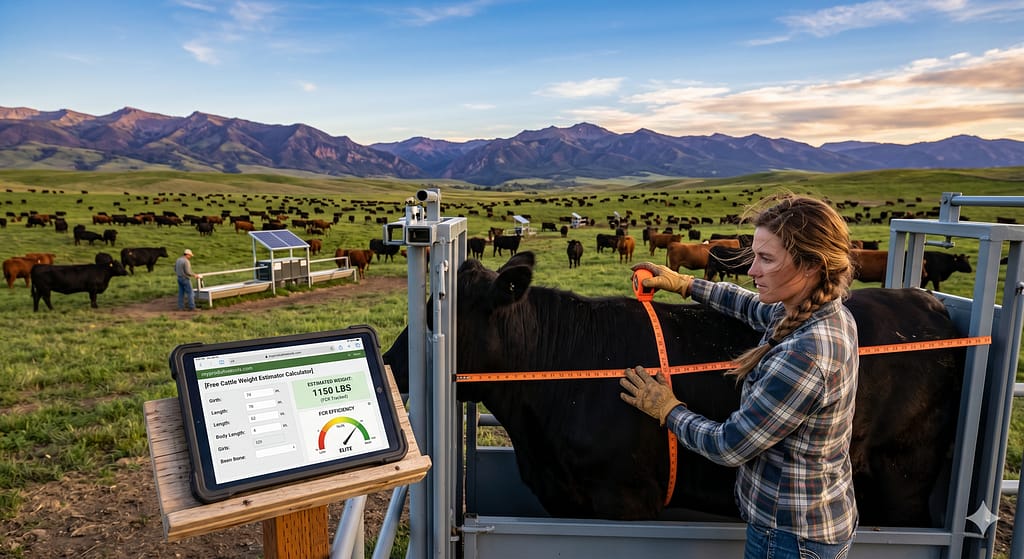
Why accurate cattle weight estimation ? Under-dosing livestock can trigger dangerous drug resistance. Learn how to estimate cattle weight without a scale to ensure precise medication and de-worming dosages.
Administering medications, vaccines, and anthelmintics (de-wormers) is a routine part of maintaining a healthy, productive herd. Whether you are running a commercial cow-calf ranch or managing a small family homestead, keeping internal parasites and bacterial infections at bay is critical for animal welfare and your bottom line. However, a widespread and dangerous practice continues to compromise herd health across the globe: dosing animals based on visual guesswork.
Many cattle handlers walk down a sorting alleyway, look at a steer, “eyeball” its size, and fill a drench gun or syringe accordingly. Because livestock weights are incredibly difficult to gauge accurately by eye alone, this approach introduces severe operational vulnerabilities.
To safeguard your animals from parasites and protect your business from wasted capital, you must establish an objective measurement protocol. By understanding how to estimate cattle weight without a scale and leveraging the digital Free Cattle Weight Estimator Calculator, you can eliminate the costly errors of visual dosing.
Why Accurate Cattle Weight Estimation: The Core Math of Precision Livestock Dosing
Veterinary pharmaceuticals are formulated to work within a specific therapeutic window. The concentration of an active chemical compound inside an animal’s bloodstream must reach a high enough threshold to kill target bacteria or parasites, without crossing into a toxic level that damages the animal’s internal organs. Because of this biochemical balance, pharmaceutical companies base all label instructions on precise body mass metrics.
For example, a standard commercial macrocyclic lactone pour-on de-wormer typically requires a dosage rate of 1 mL of product for every 22 lbs (10 kg) of body weight. If you do not know the animal’s actual weight, you cannot configure your dosing equipment accurately.
+-----------------------------------------------------------------+
|                    THE DOSAGE WINDOW BALANCING ACT              |
|                                                                 |
|  [Under-Dosing Range]  ---> Fails to kill pests, breeds bugs     |
|  [Therapeutic Window]  ---> PRECISE COMPLIANCE (Optimal Health)  |
|  [Over-Dosing Range]   ---> Toxic reactions, chemical waste     |
+-----------------------------------------------------------------+
Rather than letting your herd health ride on a random visual guess, learning how to estimate cattle weight without a scale enables you to capture precise structural numbers. By pulling a physical tape around the heart girth and checking your values against the Free Cattle Weight Estimator Calculator, you secure the exact body weight data required to compute medical dosages flawlessly.
3 Critical Risks of Guesswork Dosing in Herd Management
When you rely on visual assumptions rather than structural measurements to dose your animals, your livestock operation faces three severe health and financial risks.
1. Accelerating Parasitic Drug Resistance (The Cost of Under-Dosing)
Under-dosing is arguably the most common byproduct of visual estimation. If a handler underestimates a heifer’s weight, they will deliver an insufficient volume of active medication. While an under-dose might kill off the weakest parasites inside the animal, the strongest, most resilient worms will survive the low chemical exposure.
These surviving parasites rapidly reproduce and pass their resistant genetics on to the next generation. Over time, traditional de-worming compounds become entirely useless on your property. According to veterinary pharmacology research from institutions like the FDA Center for Veterinary Medicine, anthelmintic resistance is an escalating global crisis driven primarily by chronic under-dosing.
2. Acute Toxicity and Chemical Over-Allocation (The Cost of Over-Dosing)
Conversely, overestimating an animal’s size results in over-dosing. While some modern livestock medications feature wide safety margins, over-dosing certain chemical classes—such as levamisole or specific organophosphates—can trigger severe neurological side effects, toxic shock, or even sudden death in vulnerable calves. Furthermore, pouring excess medication onto an animal is an absolute waste of money, inflating your annual veterinary bills for no added health benefit.
3. Extended Slaughter and Milk Withdrawal Invalidation
Every commercial livestock medication features a strict legal withdrawal period—the exact number of days that must pass between the final drug administration and the harvest of meat or milk. Withdrawal timelines are calculated based on a standard metabolic clearance rate for an accurately dosed animal. If you accidentally over-dose a steer because you guessed its weight, the chemical residues may persist in its muscle tissue far longer than the label states, risking a severe violation during regulatory food safety screening.
To prevent these overlapping hazards on your property, always open the Free Cattle Weight Estimator Calculator to calculate your herd’s weight metrics before pulling any medication caps.
How to Implement a Precision Health Protocol
Shifting your operation to a data-driven health protocol doesn’t require a massive capital layout. You can achieve excellent clinical accuracy by integrating these simple management workflows:
- Group by Weight Class, Don’t Mix Randomly: If you are processing a large group of calves through a chute, take the time to run weight estimations on a sample size. Group them into uniform weight classes so you can set your dosing guns to a single, accurate setting for each specific batch.
- Calibrate Your Equipment Regularly: Drench guns and automatic syringes can lose calibration over a long season. Always pull the trigger into a graded cylinder filled with water to ensure that a 10 mL setting is physically delivering exactly 10 mL.
- Track Growth Curves Individually: Keep a permanent logbook of each animal’s tape measurements. If an animal’s weight stagnates or drops during a heavy grazing season, it serves as an early warning sign of a heavy internal parasite load or sub-clinical disease before physical symptoms appear.
+-----------------------------------------------------------------+
|                  WEEKLY HEALTH AUDIT BLUEPRINT                  |
|                                                                 |
|  1. Measure heart girth and length of target animals            |
|  2. Calculate exact weights to prevent drug resistance          |
|  3. Set drench guns based on the largest animal in the batch    |
+-----------------------------------------------------------------+
When you incorporate these steps into your routine, asking yourself “how to estimate cattle weight without a scale effectively before my vet arrives?” becomes a standard operating procedure. By combining a flexible measuring tape with the Free Cattle Weight Estimator Calculator, you gain the clarity needed to keep your livestock treatments highly effective and fully compliant.
Final Strategy: Safeguard Your Agribusiness Profits
Your herd’s health is the ultimate driver of your farm’s economic output. Allowing visual guesswork to dictate your medical investments leads to compromised immunity, drug-resistant superbugs, and wasted capital. By adopting objective anatomical tape measurements, you can protect your livestock, lower your input expenses, and extend the functional lifespan of modern veterinary medicines.
The next time you step into the working alleyway with a syringe in hand and ask yourself, “how to estimate cattle weight without a scale safely to ensure this dose hits the mark?” let mathematics guide your hand. Grab a durable tape measure, record the heart girth and frame length, and let the Free Cattle Weight Estimator Calculator handle the conversion processing for you.
For comprehensive updates on regional parasite resistance trends, rotational grazing strategies, and global biosecurity frameworks, explore the technical guidelines published by the World Organisation for Animal Health (WOAH). Stay precise, keep your herd healthy, and maximize your profits!