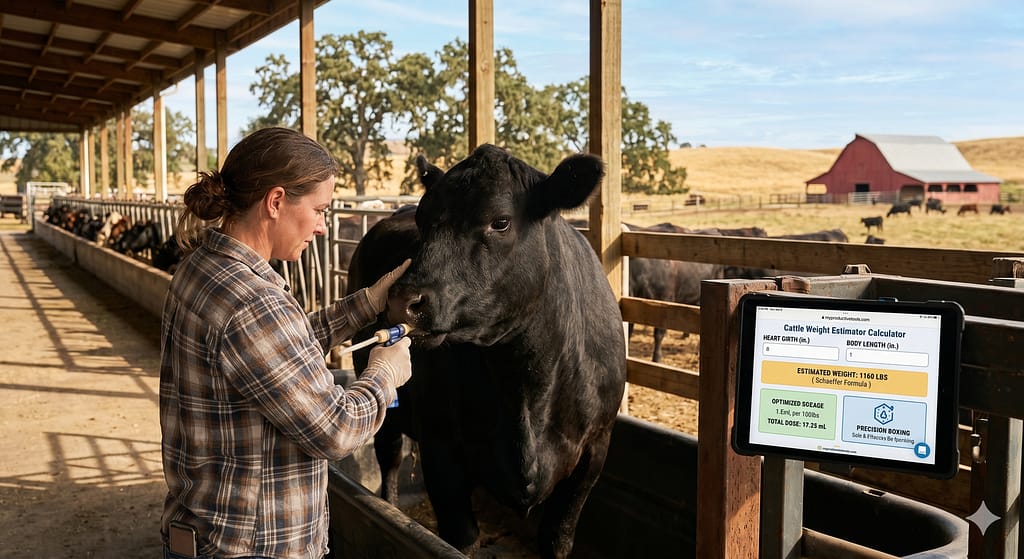
Maximizing Cattle Profit? Want to maximize your beef ranch margins? Learn how to estimate cattle weight without a scale to monitor Average Daily Gain and hit the peak market window.
In the commercial livestock sector, managing a ranch or homestead is far more than a lifestyle choice—it is a business governed by tight operational margins and cyclical market economics. Whether you are running a backgrounding operation, managing a cow-calf setup, or finishing steers on high-quality pasture, your ultimate financial success depends entirely on timing. Selling your livestock too early means leaving money on the table; holding onto them too long means burning precious cash reserves on maintenance feed.
To maximize your net return per head, you must treat your herd as dynamic financial assets. The most critical operational metric for determining market readiness is Average Daily Gain ($ADG$). ADG measures the rate of weight accumulation over a fixed period, signaling when an animal has hit its peak biological and economic efficiency.
By learning how to estimate cattle weight without a scale, monitoring your herd’s growth curves, and leveraging the Free Cattle Weight Estimator Calculator, you can make data-driven marketing decisions that secure top dollar for your livestock.
Maximizing Cattle Profit? The Economics of Average Daily Gain (ADG)
Average Daily Gain is the ultimate yardstick for measuring livestock production efficiency. It tracks how effectively an animal converts forage or grain into sellable muscle mass. The standard formula to calculate ADG manually between two check dates is:
$$\text{ADG} = \frac{\text{Ending Weight (lbs)} – \text{Beginning Weight (lbs)}}{\text{Days Between Weighing}}$$
The Law of Diminishing Returns in Beef Production
As a beef animal matures, its biological growth curve naturally begins to flatten. During the early and middle phases of development, a steer uses its feed intake primarily to build high-value muscle tissue and bone structure. However, once the animal approaches maturity, its growth shifts away from muscle deposition and toward expensive fat accumulation.
+-----------------------------------------------------------------+
|                    THE BIOLOGICAL EFFICIENCY CURVE              |
|                                                                 |
|  [Phase 1: Accelerated Growth] ---> High muscle gain, low cost  |
|  [Phase 2: THE MARKET WINDOW]  ---> PEAK EFFICIENCY (Max Profit)|
|  [Phase 3: Fat Accumulation]   ---> High feed cost, flat gain   |
+-----------------------------------------------------------------+
When an animal enters this third phase, its ADG plunges while its daily feed bill remains flat or increases. If you miss the peak market window because you cannot track this shift, your daily profit margins will quickly turn negative.
Instead of letting your financial returns ride on visual guesswork, learning how to estimate cattle weight without a scale allows you to capture precise structural numbers right in the pasture. Pulling a physical tape measure around your animals and running the results through the Free Cattle Weight Estimator Calculator provides the continuous data flow required to track your herd’s ADG curves perfectly.
3 Financial Mistakes Avoided by Precision Weight Tracking
Consistently monitoring your herd’s physical development protects your agribusiness from three major profit-draining mistakes.
1. Avoiding the “Discount Window” at Live Auctions
Commercial livestock auction barns sell cattle in highly specific, standardized weight classes. Buyers looking for backgrounder calves or feedlot replacements pay distinct price premiums for specific target weights (e.g., 500–600 lbs or 700–800 lbs). If you dump your cattle at market without knowing their exact weight, you risk falling into an unfavorable weight class where price per pound drops significantly, resulting in immediate financial loss.
2. Eliminating Ghost Feed Costs on Stagnant Cattle
If a group of steers hits a growth plateau due to internal parasites, heat stress, or poor pasture forage quality, their ADG can drop to near zero. Holding onto these animals for an extra 30 days without realizing they have stopped gaining weight means you are paying “ghost” feed costs—wasting expensive hay or grain resources on animals that are not growing.
3. Exploiting Seasonal Market Price Shifts
Livestock markets are highly seasonal, dictated by supply gluts and demand peaks throughout the year. According to agricultural commodity market reports from the USDA Agricultural Marketing Service, cattle prices fluctuate predictably based on regional weaning seasons and holiday demand. Knowing your herd’s exact growth rate allows you to project exactly when your animals will hit market weight, giving you the power to adjust feed rations and time your sales to match peak seasonal prices.
To avoid missing these lucrative market windows on your property, always log your monthly herd dimensions into the Free Cattle Weight Estimator Calculator before contacting local cattle buyers or transport haulers.
How to Build a Data-Driven Marketing Strategy
Shifting your livestock operation to a data-driven model doesn’t require high-cost electronic tracking tags or expensive hydraulic scale infrastructure. You can build a highly effective marketing framework using simple, low-cost steps:
- Conduct Monthly Sample Evaluations: You do not need to measure every single animal in a massive herd. Instead, select a random sample group representing 10% to 20% of your flock. Run regular tape evaluations on this sample group to accurately gauge the performance curve of the entire batch.
- Correlate Forage Quality to Weight Gain: Track how your animals’ ADG changes as you shift them across different rotational grazing cells. This data highlights exactly when your grass quality is declining, indicating when you need to rotate pastures or introduce nutritional supplements.
- Establish a Hard Exit Weight Baseline: Work backward from your regional market data. If local feedlots are paying peak premiums for 750-pound yearling steers, set 750 lbs as your hard exit target.
+-----------------------------------------------------------------+
|                    LIVESTOCK MARKETING CHECKLIST                |
|                                                                 |
|  1. Measure heart girth and body length monthly                 |
|  2. Calculate exact weights to monitor flock growth trends       |
|  3. Sell immediately as animals hit their target weight tier    |
+-----------------------------------------------------------------+
When you incorporate these workflows into your routine, asking yourself “how to estimate cattle weight without a scale cleanly to protect my profit margins?” becomes a routine part of your monthly business audits. By matching a standard tape measure with the processing power of the Free Cattle Weight Estimator Calculator, you secure the data clarity needed to market your livestock at peak asset value.
Final Strategy: Secure Top Dollar for Your Herd
In the modern agricultural economy, production input costs are largely dictated by volatile global supply chains. Because you cannot control the retail price of fuel, fertilizer, or grain, you must take absolute control of your farm’s internal marketing efficiency. Stop relying on loose visual guesswork to time your sales. Take regular physical measurements, calculate your herd’s changing ADG metrics, and use data to lock in peak market values.
The next time you evaluate your herd at the fence line and ask yourself, “how to estimate cattle weight without a scale accurately to capture maximum profits this season?” look to data-driven tools for the answer. Grab a durable fabric tape measure, record your animals’ heart girth and length metrics, and let the Free Cattle Weight Estimator Calculator do the heavy analytical lifting for you.
For up-to-the-minute updates on national livestock auction trends, export volume sheets, and regional beef production benchmarks, explore the business tracking tools provided by the National Cattlemen’s Beef Association (NCBA). Protect your herd, time your market, and build a highly profitable agribusiness!