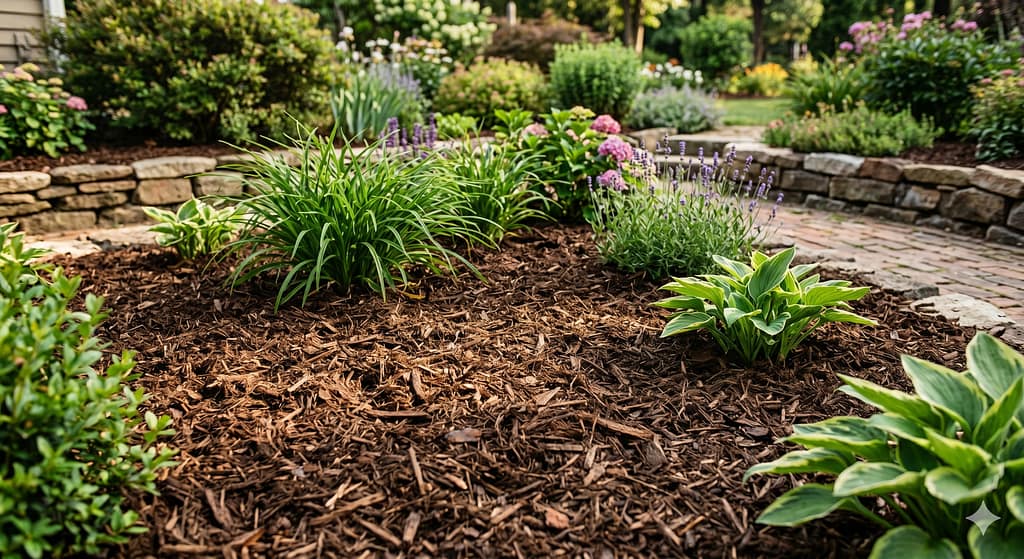
Every spring, millions of gardeners and homeowners ask themselves the exact same question: “How much garden mulch do I need?” It seems like a simple problem, but it frequently ends in one of two frustrating scenarios. Either you underestimate the project and find yourself making a third trip to the home improvement store on a Sunday afternoon, or you wildly over-estimate and end up with a massive, unsightly mountain of rotting wood chips taking up space on your driveway.
Guesswork isn’t just inefficient; it’s expensive. Getting your garden measurements right requires a basic understanding of volumetric optimization—the art and science of measuring your physical layout so you buy the exact amount of material required.
In this beginner-friendly guide, we will break down how to accurately measure your yard, convert your layout into cubic measurements, and use the free Garden Soil & Mulch Calculator to eliminate the guesswork entirely.
Why Precise Mulch Calculations Matter
Before grabbing your tape measure, it’s vital to understand why precision matters. In landscaping, mulch is rarely sold by simple length or width. Instead, it is sold by volume—typically in cubic feet for retail bags, or cubic yards for bulk commercial deliveries.
Getting this math right protects your wallet, your time, and your plants:
- Preventing Plant Suffocation: Spreading material too thickly restricts oxygen from reaching the soil structure, causing root rot and inadvertently killing your plants.
- Weed Control Efficiency: Spreading material too thinly allows sunlight to break through, triggering dormant weed seeds to sprout across your flower beds.
- Financial Waste: Bulk delivery fees can easily exceed the cost of the raw material itself. Ordering the wrong amount means paying for multiple deliveries or wasting money on product you can’t use.
If you want to skip the manual math immediately, you can open up the Garden Soil & Mulch Calculator in another tab to follow along with the steps below.
Step 1: Calculate Total Square Footage
The foundation of solving the “how much mulch do I need” equation relies entirely on calculating your total surface area in square feet ($sq\;ft$).
Geometric Shapes and Formulas
Most residential garden layouts can be broken down into basic geometric shapes. Here is how to handle the most common configurations:
- Rectangles and Squares: This is the easiest layout. Multiply the total length by the total width.$$\text{Area} = \text{Length} \times \text{Width}$$
- Triangles: If you have a corner bed, measure the flat base and the height (from the base to the opposite point).$$\text{Area} = \frac{\text{Base} \times \text{Height}}{2}$$
- Circles: For a freestanding island bed or around a focal tree, measure from the center of the tree trunk out to the outer edge of the grass line to find your radius ($r$).$$\text{Area} = \pi \times r^2$$
Pro-Tip for Irregular Shapes: If your garden beds wind dynamically across your lawn, do not panic. Break the irregular space down into smaller, manageable individual rectangles and circles. Calculate the square footage of each small subsection independently, then add those sums together to get your total square footage.
Step 2: Determine Your Ideal Depth Configuration
Once you know the flat surface area of your landscape beds, you need to decide how deep the material layer should be. Volumetric optimization requires a height measurement alongside length and width.
The standard recommended depth for traditional wood chips, bark, or compost is 3 inches for standard weed suppression. However, your specific depth configuration will depend entirely on what you are trying to accomplish:
| Mulch Function | Recommended Depth | Notes |
| Brand New Garden Beds | 3 to 4 inches | Needed to initially smother aggressively growing lawn grass and weeds. |
| Established Flower Beds | 1 to 2 inches | An annual refresh to maintain appearance and top off decomposed material. |
| Vegetable Gardens | 2 inches | Straw or shredded leaves work best here; thinner layers prevent trapping too much moisture around delicate roots. |
| Pathway & Playground Areas | 4 to 6 inches | Deep layers are vital here to handle heavy foot traffic and cushion impacts. |
Crucial Warning: Never pile material directly against tree trunks or the woody stems of shrubs. This practice, known as “mulch volcanoing,” traps destructive moisture against the bark, attracting boring insects and fungal diseases. Always pull the material back 2 to 3 inches from the base of the plant.
Step 3: Run the Volumetric Formulas
Now that you have gathered your square footage and your target depth, it is time to convert those dimensions into a three-dimensional volume.
Because depth is typically measured in inches while surface area is measured in feet, you must convert your inches into a fraction of a foot before multiplying. To do this manually, use the following formula:
$$\text{Cubic Feet} = \text{Square Footage} \times \left(\frac{\text{Depth in Inches}}{12}\right)$$
For example, let’s say you have a backyard garden bed that is $200\text{ sq ft}$, and you want to apply a standard depth of $3\text{ inches}$.
$$\text{Cubic Feet} = 200 \times \left(\frac{3}{12}\right) = 200 \times 0.25 = 50\text{ cubic feet}$$
Converting to Cubic Yards
If you are ordering bulk truck deliveries from a local nursery, they will expect your order in cubic yards rather than cubic feet. Because there are 27 cubic feet in a single cubic yard, you must divide your total cubic feet by 27:
$$\text{Cubic Yards} = \frac{\text{Total Cubic Feet}}{27}$$
Using our previous example:
$$\text{Cubic Yards} = \frac{50}{27} \approx 1.85\text{ cubic yards}$$
If you want to completely avoid doing this manual math altogether, simply input your measurements into the Garden Soil & Mulch Calculator to get an instant, error-free breakdown of your volume demands.
Step 4: Bagged vs. Bulk – Choosing the Right Purchasing Option
Once you have solved the ultimate question—how much garden mulch do I need—you must decide how to buy it. Your volumetric results will point you directly toward the most economical option.
When to Buy Bagged Material
Standard retail bags found at local garden centers generally come in sizes of 2.0 cubic feet or 3.0 cubic feet.
- The Rule of Thumb: If your calculated requirement is under 20 to 30 cubic feet, buying individual bags is highly efficient.
- Pros: Easy to transport in a standard car trunk, simpler to distribute precisely around tight flower arrangements, and easy to store if you have extras left over.
When to Buy Bulk Material
Bulk material is delivered loose via a dump truck or picked up using an open-bed commercial utility trailer.
- The Rule of Thumb: If your total project volume exceeds 1 cubic yard (27 cubic feet), you should strongly consider ordering in bulk.
- Pros: Drastically lower cost per cubic foot, zero plastic bag waste to clean up and throw away, and a much cleaner look across large landscapes.
According to consumer landscape economic data from University Extension offices like the NC State Extension, buying in bulk can save homeowners upwards of 50% on raw material costs compared to buying equivalent volumes in individual plastic retail bags.
Step 5: Put Your Data to Work
Let’s walk through an applicable real-world scenario. Imagine you have a long, rectangular front-yard landscape layout that measures 40 feet long by 6 feet wide. You want a lush 3-inch blanket of premium dark hardwood bark to suppress pesky weeds and retain moisture during hot summer droughts.
- Calculate the Area: $40 \times 6 = 240\text{ square feet}$.
- Apply the Volumetric Math: $240 \times (3 \div 12) = 60\text{ cubic feet}$.
- Determine the Bag Count: If buying standard 2-cubic-foot bags, you will need exactly 30 bags ($60 \div 2 = 30$).
- Determine Bulk Yardage: $60 \div 27 = 2.22\text{ cubic yards}$.
Instead of stressing over the math or accidentally miscalculating conversions on a scratchpad, using the automated Garden Soil & Mulch Calculator streamlines this entire process down to a few clicks, outputting your requirements instantly.
In conclusion: Master Your Next Landscaping Project
Landscaping shouldn’t involve guessing games. By executing basic volumetric optimization, you can protect your garden’s root systems, maintain healthy soil temperature balances, and ensure your home’s curb appeal looks professionally curated.
The next time you find yourself staring at your yard wondering, “how much garden mulch do I need for this project?” simply step outside with a tape measure, outline your primary geometric zones, and let technology do the heavy lifting for you.
For more tips on choosing the perfect organic materials for your property, consult the comprehensive tree and plant care databases provided by the International Society of Arboriculture (ISA). Happy planting!