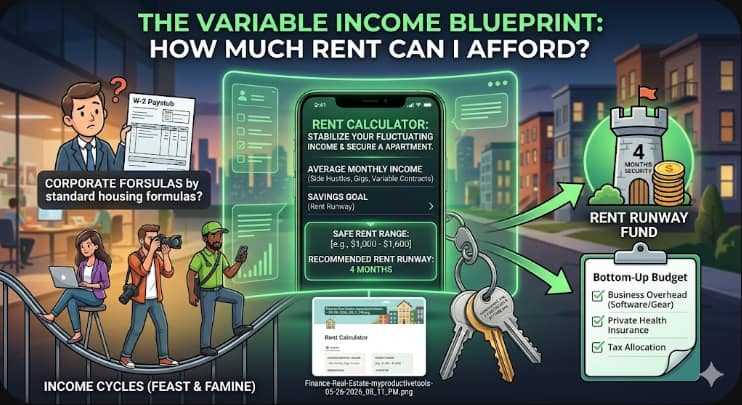
How much rent can I afford with a variable income or side hustle : Struggling with how much rent can I afford with a variable income or side hustle? Discover 7 proven strategies to budget smarter today.
Figuring out how much rent can I afford with a variable income or side hustle is one of the most stressful financial puzzles a freelancer, gig worker, or commission-based professional can face. Unlike a salaried employee who gets the same paycheck every two weeks, your income can swing from feast to famine — sometimes within the same month. Standard budgeting advice built around fixed paychecks simply doesn’t apply to you.
The good news? You don’t need a predictable salary to afford rent responsibly. You need a smarter system. These 7 proven strategies are designed specifically for non-traditional earners who are tired of generic advice that doesn’t account for their financial reality.
1. Calculate Your “Floor Income” Instead of Your Average
Most rent affordability calculators ask for your monthly income. That works if you earn the same amount every month — but what if your income fluctuates by $1,000 or more? Using your average income can set you up for failure during low-earning months.
Instead, calculate your “floor income” — the lowest amount you reliably earn in your worst months over the past 12 months. Base your rent budget on that number, not your average or your best month. This single shift protects you from being unable to cover rent when a big client cancels or gig work slows down.
For example, if your monthly income over the past year ranged from $2,200 to $4,800, your floor income might sit around $2,200 to $2,500. Use this rent affordability calculator to plug in your floor income and get a realistic rent ceiling.
2. Apply the 30% Rule — But Make It Variable
You’ve probably heard the rule: spend no more than 30% of your gross income on rent. For salaried workers, this is straightforward math. For variable earners, it requires a twist.
Rather than calculating 30% of your average monthly income, apply it to your floor income. This is your absolute rent ceiling. Then, when you have a high-income month, bank the difference into a dedicated rent buffer fund rather than upgrading your lifestyle.
According to the U.S. Department of Housing and Urban Development (HUD), housing cost burden begins when you spend more than 30% of your income on housing. For variable earners, this threshold is even more critical to respect since a bad month can quickly turn a manageable rent into a crisis.
3. Build a 3-Month Rent Reserve Before Signing a Lease
Salaried renters rarely think about a rent reserve fund. Variable income earners can’t afford not to have one. Before committing to any lease, build a reserve equal to at least 3 months of rent sitting untouched in a separate savings account.
This buffer does two powerful things. First, it protects you from missing rent during a low-income stretch. Second, it gives you breathing room to make strategic business decisions — like turning down a low-paying client — without panicking about covering your housing costs.
If you’re a freelancer averaging $3,500/month and considering a $1,050/month apartment (the 30% threshold), your rent reserve target is $3,150. Set that aside before you sign anything.
4. Separate Your Side Hustle Income From Your Rent Budget
When asking yourself how much rent can I afford with a variable income or side hustle, one of the most dangerous mistakes is counting every income stream equally. Side hustle income — whether it’s Etsy sales, weekend rideshare driving, or occasional freelance gigs — is inherently unpredictable.
The smart move is to treat your side hustle income as bonus money, not core income. Your primary rent budget should be based only on your most consistent income source. Use side hustle earnings to accelerate your rent reserve fund, pay down debt, or cover one-time expenses.
This mental separation keeps your housing situation stable even when your side hustle has a slow month. You can calculate your rent budget based on your core income alone and see exactly what percentage side hustle earnings would represent.
5. Use Annualized Income for a More Accurate Rent Calculation
How much rent can I afford with a variable income or side hustle: Monthly snapshots of your income can be wildly misleading when you work in freelance, real estate, commissions, or seasonal gigs. A commission-based sales rep might earn $8,000 in March and $1,200 in July. Looking at either month alone tells you almost nothing useful.
Instead, divide your total annual income by 12 to get a true monthly average, then apply the 30% floor income rule against it. Cross-reference that with your three worst months of the year to stress-test whether you could actually cover the rent every single month.
Quick Annualized Income Formula for Variable Earners:
- Add up all income earned over the past 12 months
- Divide by 12 to get your true monthly average
- Multiply by 0.30 to get your absolute rent ceiling
- Compare that figure against your 3 worst months — if you can cover it then, you’re safe
6. Negotiate Flexible Lease Terms When Possible
Most people assume rent is non-negotiable. It often isn’t — especially in slower rental markets or with private landlords. When your income varies, getting flexibility built into your lease can make a real difference.
Consider negotiating for: a lower base rent in exchange for a longer lease commitment, permission to pay rent biweekly to align with how income arrives, or a grace period clause that gives you extra days before late fees kick in. These aren’t guarantees, but many landlords — particularly private owners — are open to reasonable conversations, especially from tenants who come prepared with a strong rental history and healthy references.
Understanding how much rent can I afford with a variable income or side hustle also means knowing your non-negotiables. If a landlord won’t budge on any terms, that rigidity could become a serious problem during an income dip. Factor in that risk before signing.
7. Track Income Patterns and Adjust Rent Budgets Annually
Variable income earners often make the mistake of treating their rent budget as a one-time decision. It isn’t. Your income patterns will shift over time as you grow your freelance business, pick up new clients, lose contracts, or pivot your side hustle.
Build an annual review into your financial routine. Every 12 months, reassess your floor income, recalculate the 30% threshold, and evaluate whether your current rent still fits your updated income reality. If your floor income has grown significantly, you might comfortably afford a better apartment. If your income has become less predictable, you may want to downsize or boost your reserve fund.
Tools like a dedicated rent affordability calculator built for your real budget make this annual review fast and clear. Plug in your updated numbers and get an immediate snapshot of where you stand.
For additional guidance on budgeting and housing costs, the Consumer Financial Protection Bureau (CFPB) offers free budgeting tools and resources tailored to real-world income scenarios.
Final Thoughts: Renting Smart on a Variable Income Is Absolutely Possible
How much rent can I afford with a variable income or side hustle: The question of how much rent can I afford with a variable income or side hustle doesn’t have a one-size-fits-all answer — and that’s exactly the point. Your income situation is unique, and your rent strategy needs to reflect that reality.
By basing your budget on floor income, building a rent reserve, separating side hustle earnings from core housing costs, and reviewing your numbers annually, you shift from reactive financial stress to proactive financial confidence. Rent doesn’t have to feel like a gamble just because your paycheck varies.
Start with honest numbers. Use a rent calculator designed for real-world budgeting, apply the strategies above, and stop letting a fluctuating income keep you from making a smart, stable housing decision. You’ve got this.