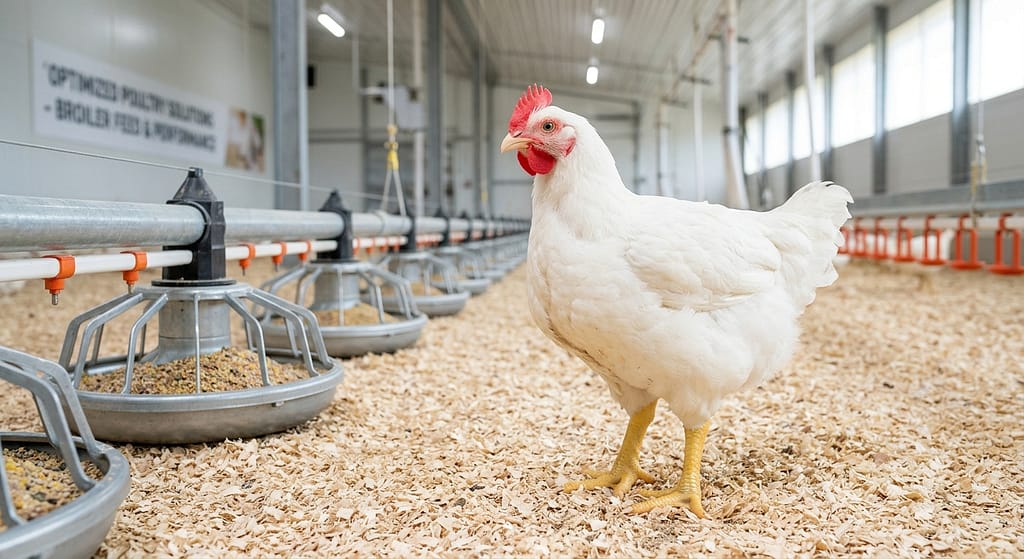
In the commercial poultry industry, feed is your largest recurring expense, consistently swallowing up 60% to 70% of total production costs. When your birds waste feed or fail to convert it efficiently into body weight, your hard-earned profits literally end up swept into the manure pit. If you want to run a highly successful poultry business, you must master your Feed Conversion Ratio (FCR).
Learning how to lower your broiler FCR and reduce feed waste is the absolute fastest way to cut down your operational costs and scale your farm’s income. This guide provides actionable, field-tested management tactics to optimize your birds’ digestion, stop feed spillage, and maximize your flock’s market value.
Understanding the Biological Foundation of FCR
Before you can actively lower your Feed Conversion Ratio, you must understand what this metric truly represents from a biological standpoint. FCR is not just an arbitrary economic number; it is a direct measurement of your flock’s metabolic efficiency. Mathematically, it represents the kilograms of feed required to produce a single kilogram of live body weight.
In modern commercial strains like Cobb 500, Ross 308, or Hubbard, genetic selection has pushed biological boundaries.These genetic advancements require precise environmental management, as highlighted by the global poultry research at Aviagen…” These birds have an incredible capacity for rapid protein synthesis. Under absolute textbook laboratory conditions, a modern broiler can achieve an FCR as low as 1.4 to 1.5. This means for every 1.4 kilograms of feed consumed, the bird lays down 1 kilogram of high-quality muscle tissue.
However, on a practical open-sided or even environmentally controlled commercial farm, real-world stressors interfere with this genetic potential. When a bird encounters cold air, high microbial loads, poor ventilation, or bad feeder design, its biological priorities shift. Instead of routing amino acids and dietary energy straight into breast meat development, the bird’s metabolism diverts those resources toward basic survival mechanisms—like immune responses, cellular repair, and internal heat generation.
As a poultry farm manager, your goal is to eliminate these environmental and physical disruptions. By creating a frictionless environment where the bird can allocate 100% of its nutritional intake toward growth, you naturally bring down your farm overhead.
1. Optimize Your Feeder Height and Design Settings
One of the primary causes of artificial feed inflation is physical spillage. If your equipment is set incorrectly, broilers will use their heavy beaks to scratch expensive feed directly out of the pans onto the litter floor. Once feed hits the ground, it mixes with wood shavings and manure, turning into a biological hazard that your birds will never touch.
To stop this financial drain, implement these physical adjustment rules:
The Back-Height Leveling Rule
You cannot set your hanging winches once at the beginning of a cycle and forget about them. Broilers grow with explosive speed, altering their body dimensions every 48 hours. You must adjust your hanging winches manually at least twice a week.
The lip of your feeding pans must always sit perfectly level with the average back height of the standing broilers. If the pans are hung too low, the birds can easily stand over the feed, scratch with their feet, and scoop feed outward with their beaks. If they are hung too high, smaller birds in the flock cannot comfortably access the nourishment, leading to flock uniformity issues and stunted average weights.
Managing Feed Lip Fill Depth
Never fill open feeding pans to the brim. The deeper the feed layer inside a pan, the easier it is for a chicken to spill it. As a strict rule of thumb, maintain the feed depth at roughly one-third of the pan’s total capacity.
If you are using manual tube feeders, adjust the bottom adjustment brackets downward to restrict the gravity flow of feed into the tray. If you are using an automated pan feeding line, program your proximity sensor switches at the end of the line to run shorter, more frequent feeding bursts rather than filling the track completely. Utilizing modern anti-scratch fins or specialized grilles on your pans also prevents birds from thrashing their heads side-to-side while eating.
2. Secure Continuous Access to Cool, Clean Water
It is a biological fact that a broiler chicken cannot digest food without water. The metabolic relationship between consumption metrics is incredibly strict: broilers drink roughly twice as much water by weight as they eat feed. If your water supply drops for even a few hours, your feed consumption drops right along with it, stalling growth and sending your FCR off a cliff.
Temperature Restrictions and Apprehension
Broilers do not possess sweat glands; they cool themselves primarily through evaporative cooling via panting. Because of this, their water temperature preference is incredibly precise. Broilers will drastically reduce their water intake—or refuse to drink altogether—if the water inside your pipeline gets too warm (above 30°C / 86°F).
During hot afternoons, stagnant water inside PVC overhead pipes can quickly match the ambient room temperature. You must flush your water lines manually or utilize automated flushing systems twice a day during peak heat periods to keep the water cool, crisp, and inviting.
       [ Water Intake Drops due to Warm Pipes ]
                           │
                           ▼
          [ Digestion and Appetite Stall ]
                           │
                           ▼
     [ Extended FCR and Lost Muscle Synthesis ]
Flow Rate Verification via Nipple Drinkers
Check your nipple drinker line pressure frequently. Low water pressure forces birds to spend vital energy pecking repeatedly just to get a single drop. This unnecessary physical exertion burns calories that should be going toward meat synthesis.
Conversely, if the pressure is too high, the nipples will leak constantly, saturating the floor below. Use a measuring cup to test your nipple flow rates weekly. A general guide is 20 to 30 ml per minute for birds in their first two weeks, scaling up to 60 to 80 ml per minute for mature broilers approaching market weight.
3. Implement a Scientifically Proven Lighting Schedule
Many beginner poultry farmers leave their coop lights on 24 hours a day, mistakenly believing that constant eating leads to faster growth. In reality, this practice damages feed efficiency.
Without a dedicated period of darkness, a bird’s digestive tract never gets a chance to rest. The feed moves through their intestines too quickly via peristalsis, meaning their bodies fail to absorb vital micronutrients and amino acids before excreting it as wet manure.
The Biological Necessity of the Rest Window
Introduce a structured lighting program providing 4 to 6 hours of total darkness every night after the first week of brooding. Darkness triggers the natural release of melatonin, a vital hormone that regulates immune health and bone development.
Furthermore, during the dark period, the bird’s metabolic rate slows down, allowing its digestive system to thoroughly process and absorb the remaining contents of its crop and gizzard.
The Hidden Benefits of Uniform Behavior
When the lights click back on after a period of darkness, it triggers a uniform feeding behavior across the entire barn. Birds move to the feeders simultaneously, which reduces competitive stress and encourages weaker birds to eat alongside dominant ones. This simple behavioral shift dramatically improves nutrient absorption, naturally helping you learn how to lower your broiler FCR and reduce feed waste without changing your feed brand or purchasing expensive additives.
4. Enforce Impeccable Bio-Security and Gut Health
A bird can eat the most expensive, premium feed on the market, but if its gut lining is inflamed or damaged by microscopic parasites, it will never convert that nutrition into breast meat. Pathogenic disease loads are a massive, silent driver of terrible farm FCR scores globally.
Guarding Against Subclinical Coccidiosis
Coccidiosis is an intestinal disease caused by microscopic protozoan parasites called coccidia. While clinical outbreaks cause obvious signs like bloody diarrhea and mortality, it is the subclinical version that destroys your bank account. Subclinical coccidiosis doesn’t kill the bird; instead, it subtly damages the delicate villi lining the small intestines.
When these tiny, finger-like absorption structures are blunted or destroyed, the surface area of the gut drops significantly. The feed passes through unabsorbed. A sick bird still eats your feed to survive, but its growth stalls out entirely.
+-------------------------------------------------------------+
|                     THE GUT HEALTH CHAIN                    |
|                                                             |
|  Healthy Villi  --> High Surface Area --> Optimal FCR (1.6)  |
|  Damaged Villi  --> Low Surface Area  --> Poor FCR (2.2+)   |
+-------------------------------------------------------------+
Managing Litter Quality to Stop Bacterial Proliferation
Keep your wood shavings dry. Wet litter breeds harmful bacteria like Clostridium perfringens, the root cause of necrotic enteritis. Furthermore, wet litter undergoes chemical breakdown, releasing toxic ammonia gas into the air.
High ammonia levels irritate the respiratory tracts and eyes of your broilers, causing metabolic stress. When a bird is fighting off environmental stress and low-grade gut infections, its immune system hogs all the dietary energy, leaving nothing left for muscle production.
5. Control the Temperature Inside Your Poultry Barns
Broilers are warm-blooded animals, meaning their bodies use feed as fuel to maintain a steady internal core temperature. When your barn environment steps out of the biological comfort zone (the thermoneutral zone), your feed budget pays the price.
Cold Stress Realities and Caloric Deficits
If your coop drops below the recommended temperature curve—especially during the night or early morning hours—broilers will instinctively consume extra feed simply to generate internal body heat. They aren’t growing larger or packing on marketable meat; they are burning your expensive feed like firewood just to stay warm. If your house is drafty or poorly insulated, your birds will look like they are eating well, but your weekly FCR calculation will look terrible.
Heat Stress Hazards and Panting Burnout
Conversely, when the coop gets too hot, birds encounter heat stress. To dump core heat, they begin panting heavily. Panting requires muscular effort, which burns calories while causing respiratory alkalosis.
To cope, birds drop their feed intake significantly while overloading on water. This results in flushing (watery diarrhea), which ruins litter conditions and further decreases their metabolic efficiency. Use misting systems, extraction fans, and proper ventilation spacing to keep your birds perfectly comfortable.
6. Audit Your Flocks with Digital Performance Trackers
You cannot manage what you do not measure. To truly understand if your management changes are working, you must calculate your performance metrics at the end of every single week.
Do not wait until day 42 when the harvest trucks arrive to realize your feed efficiency was poor. By then, it is too late to fix your financial losses.
Setting Up a Weekly Sampling Workflow
Every seven days, catch and weigh a random sample group of at least 5% of your flock from different areas of the poultry barn. Calculate the average body weight of these birds. At the same time, count exactly how many 50 kg feed bags your flock consumed during those seven days.
By plugging these weekly weight increments and cumulative feed totals into a tracking system, you can catch performance drops early. If you see a sudden spike in your weekly FCR curve, you know immediately to check for leaking water lines, disease outbreaks, or feed spillage issues.
Final Verdict: Protect Your Farming Profit Margins
Discovering how to lower your broiler FCR and reduce feed waste is not about buying cheap, low-quality feed—it is about mastering your daily management protocols. By keeping your feeder levels low, keeping your water lines cool, providing structured darkness, and monitoring environmental stress, you can easily pull your FCR score into the highly profitable 1.5 to 1.7 bracket.
Protect your margins, watch your birds closely, and run a data-driven farm to maximize your final harvest revenue.
Automate Your Poultry Metrics Instantly
- Check Your Farm’s Efficiency: Stop guessing your production tier! Drop your latest flock data directly into our free Broiler & Layer Feed Conversion Ratio Calculator to instantly audit your performance score.
- Plan Your Next Feed Batch: Trying to budget for your next flock? Use our advanced Poultry Feed Conversion Ratio Tool to run complete raw feed allocation projections based on your custom target targets.