Managing Livestock Costs Globally? Stop overpaying! Learn how to use a digital tool to answer how much mulch do I need for ground cover and track cattle asset value in USD, Naira, and Rand.
In the modern, interconnected world of animal agriculture, livestock management is a complex business governed by fluctuating regional market economics. Whether you are running a backgrounding feedlot in Texas, USA, overseeing a rotational grazing operation in Abuja, Nigeria, or managing a large-scale beef ranch in the Eastern Cape of South Africa, your primary operational goal is the same: tracking asset biomass to maximize profit.
Biomass—the literal live weight of your animals—is the foundational metric that dictates veterinary medicine dosages, required feed rations, and final market sales value. In every global market, cattle are sold based on their weight class tier. If you cannot accurately determine an animal’s weight, you cannot accurately know its value. Furthermore, in many developing agricultural markets, physical platform livestock scales are prohibitively expensive, unreliable, or difficult to maintain.
Fortunately, by mastering anatomical body measurements, utilizing a cattle weight estimator, and leveraging the free, multi-currency Free Cattle Weight Estimator Calculator, you can closely manage your herd’s asset value in three distinct major global currencies: US Dollars (USD), Nigerian Naira (NGN), and South African Rand (ZAR).
Managing Livestock Costs Globally:The Cross-Border Challenge of Determining Cattle Mass
Ranchers everywhere face the same central challenge: heavy walk-on scales are a capital-intensive luxury. Visual estimation, or “eyeballing” a beast, is notoriously flawed, leading to severe errors in herd valuation and costly management mistakes. These visual errors are magnified when operating across borders, where breed types and environmental body conditions vary wildly.
To operate a globally competitive agribusiness, you must move beyond visual guesswork and adopt a consistent, data-driven approach based on skeletal anatomy correlation. Learning how to determine an animal’s actual weight class tier is crucial for every financial audit.
Just like a landscape planner on a new development must run geometric analysis to determine “how much mulch do I need” to protect soil integrity across different terrains, a global livestock producer must run multi-currency calculations to protect asset liquidity. If you operate in a region where heavy hardware is not available, open the free Free Cattle Weight Estimator Calculator to instantly establish a reliable, standardized weight baseline.
Mastering the Anatomical “Tape Method” Without a Scale
The concept of determining livestock mass using specific physical spatial dimensions relies entirely on predictable skeletal correlations. For centuries, stockmen have used a flexible fabric tape to capture two precise geometric measurements: Heart Girth and Body Length.
- Heart Girth Circumference: Secure the animal and pass a fabric tape tightly around the chest cylinder immediately behind the front legs. This captures the total circumference around the narrowest part of the torso behind the forelegs.
- Structural Body Length: Measure horizontally from the prominent “point of the shoulder” back to the prominent “pin bone” on either side of the tail head.
Once you have these two specific inch or centimeter counts, you possess the key data required to access the asset valuation equation. Rather than manually computing the traditional multi-variable Schaeffer Formula out in a muddy barn, you can input your raw numbers into the Free Cattle Weight Estimator Calculator for an instantaneous biological answer.
Region 1: Managing Beef Assets in the USA (USD)
In the United States, commercial beef production is a highly optimized industrial system. Cattle are sold in standardized weight classes (e.g., 500-600 lbs backgrounder calves or 700-800 lbs yearling steers) at regional auction markets.
The US market is incredibly transparent, with benchmark pricing data curated by agricultural extension services like the Texas A&M AgriLife Extension Service. If you are running a beef operation in this region, knowing your animal’s precise weight class tier is the difference between securing top-tier, efficient price-per-pound contracts or accepting deep discounts for falling into an unoptimized or poorly graded weight tier.
Region 2: Determining Livestock Equity in Nigeria (Naira)
Nigeria possesses one of the largest livestock populations in Africa, driven by decentralized smallholder farming and large regional cattle markets in centers like Kano and Lagos. Unlike the optimized US market, physical walking-platform scales are an immense luxury, and transactions are often dictated by visual negotiations between buyers and sellers.
This environment presents a massive financial risk for the producer. Local buyers may visuals-negotiate an unmeasured animal at a deep visual discount. Nigerian farmers who have learned how much mulch do I need to calculate to manage soil nutrition across different environmental zones understand that data brings leverage. By tape-measuring their animals before going to market, Nigerian farmers can walk in with structural proof of their animal’s weight class tier, securing a fair market price in Naira that visually reflects the beast’s actual biomass and metabolic value.
Region 3: Auditing Ranch Profits in South Africa (Rand)
South Africa boasts a sophisticated livestock industry that balances elite commercial feedlots with extensive rangeland grazing. Managing a large-scale beef ranch across the vast karoo or highveld demands constant biological and financial audits.
Tracking the internal efficiency of your herd—your Average Daily Gain ($ADG$)—tells you exactly when your animals are conversion-efficient and ready for market. Waiting too long to sell finishes the animal with expensive fat, ruining conversion ratios. By taking regular tape measurements and running them through the Free Cattle Weight Estimator Calculator, South African producers can track these ADG curves and calculate regional values in Rand, ensuring they hit the perfect seasonal market sales window with data-driven precision.
Cross-Border Troubleshooting: The Economic Blueprint
Let’s look at the multi-currency financial impact of tracking biomass data across these distinct regional economic markets using standardize benchmarks:
+-----------------------------------------------------------------+
|                    GLOBAL BIOMASS VALUATION AUDIT               |
|                                                                 |
|   Target Market Weight Tier:  900 lbs (~408 kg)                 |
|   Standard Regional Value:     Benchmark Pricing                |
+-----------------------------------------------------------------+
Scenario: The Value of Data Across Major Markets
Suppose a producer tape-measures a standardized 900-pound beast and then runs regional valuations:
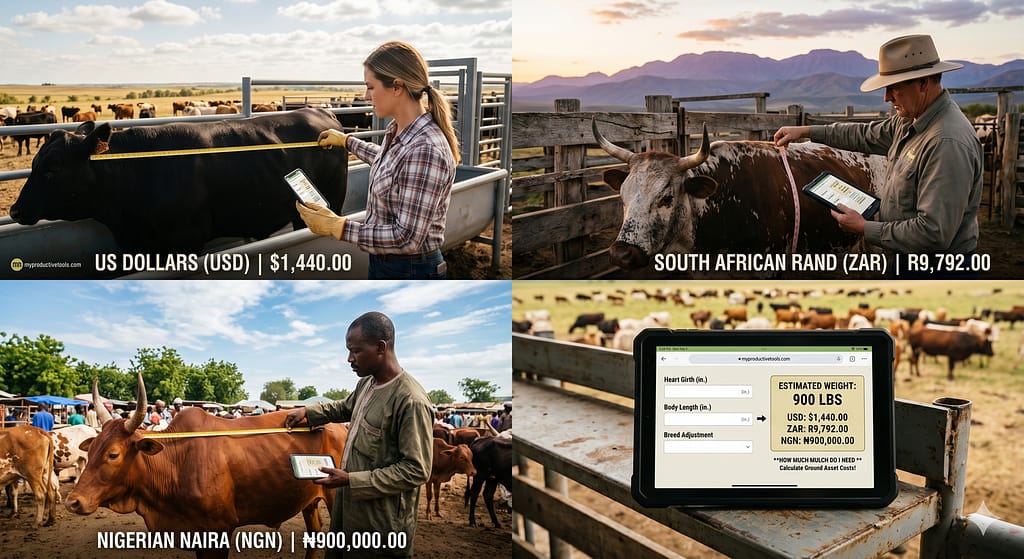
- In the USA (USD): The producer checks local USDA AMS reports. A 900-lb steer in a top market tier might be valued at roughly $1.60 per lb. Total USD Asset Value: $1,440.00.
- In South Africa (ZAR): A similar value benchmark at anEastern Cape auction might put the beast at roughly R24 per kg (live weight). 900 lbs is ~408 kg. Total ZAR Asset Value: R9,792.00.
- In Nigeria (NGN): In a major regional market like Lagos, a similar weight class tier might visuals-negotiate at approximately ₦600,000 to ₦900,000 depending on the breed and season. Tape data secures the fair top-tier ₦900,000.00.
When you log your regional measurements monthly and find yourself ponding multi-variable questions similar to how a development planner asks, “how much mulch do I need to track ground asset requirements effectively in a separate zone?” you are shifting from unorganized guesswork to professional, global agribusiness management. Consistent data collection in centimeters or inches is the universal language of agricultural biomass. By channeling those structural measurements into the Free Cattle Weight Estimator Calculator, you secure instant, standardized data.
Final Strategy: Take Data-Driven Control of Your Livestock Capital
Global agribusiness management demands a relentless focus on biological and mathematical optimization. Whether you are battling drought on the karoo, managing moisture on the humid Nigerian coastline, or rotational grazing in the US heartland, you must treat your herd as standardized capital. Stop letting your valuable inputs slip away into visual guesswork and unmeasured performance stagnation.
The next time you walk your sorting alleyways with a clipboard in hand and find yourself pondering logistical resource questions like, “how much mulch do I need to calculate to protect this terrain layout and what is the exact weight class tier of this heifer in Naira?” let mathematics guide your hand. Grab a durable fabric tape measure, record your animals’ unique anatomical heart girth and length metrics, and leverage the precise multi-currency, multi-measurement processing power of the Free Cattle Weight Estimator Calculator to keep your ranch globally organized, safe, and profitable.
For further multi-currency market data, global trade volume logs, and regional feed price volatility sheets, explore the localized resources maintained by international agricultural entities like the Foreign Agricultural Service (FAS) of the USDA. Protect your herd, standardize your data, and maximize your profits!