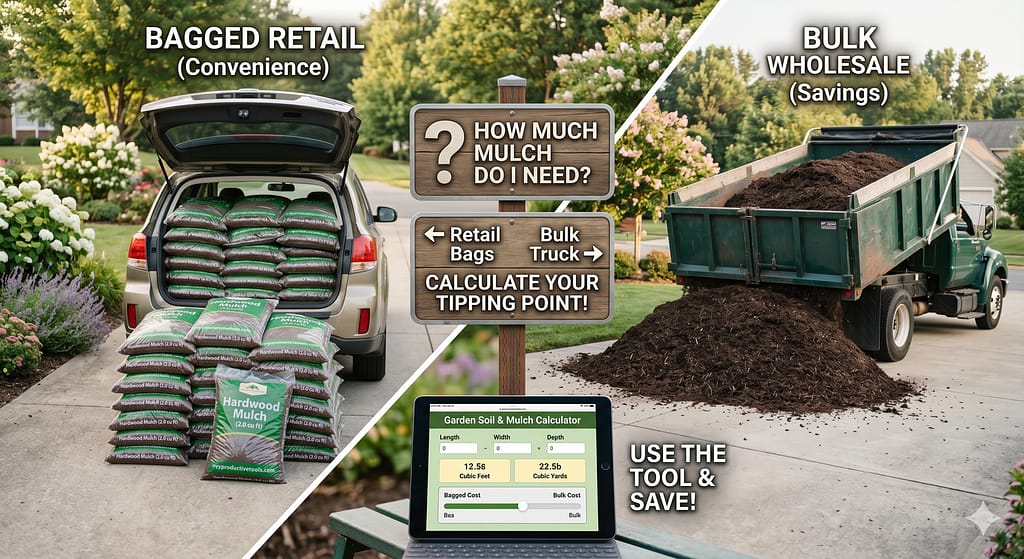
Bagged vs. Bulk Mulch: Stop overpaying at the garden center! Learn how to use a digital calculator to answer how much mulch do I need and find the exact financial tipping point between bagged and bulk.
Every year, homeowners and property managers face a common dilemma when upgrading their outdoor landscapes. You look out at your empty flower arrangements, walkway paths, and garden beds, and you know it’s time to apply a fresh layer of protective ground cover. But as you prepare to buy materials, you run into a major fork in the road: should you buy individual plastic bags from a local home improvement center, or should you call a local landscape supply yard to order a loose bulk truck delivery?
This choice isn’t just about physical convenience; it is a significant financial decision that can swing your project budget by hundreds of dollars. Many buyers choose a packaging format completely at random, only to realize midway through their weekend that they overpaid drastically for their materials.
To save the maximum amount of cash on your next property upgrade, you must understand how to mathematically locate the structural breakpoint between these two options. By running a head-to-head comparison and using the Garden Soil & Mulch Calculator, you can strip away the guesswork and pinpoint the exact purchasing method your layout demands.
The Core Math of Volumetric Sizing
The biggest reason consumers struggle to compare bagged and bulk pricing options accurately is that the two formats use completely different units of measurement. Retail bags are sold using cubic feet, whereas commercial bulk operations sell material using cubic yards.
Before you can compare unit costs, you have to answer the ultimate foundational question of your project: “how much mulch do I need” in total volume?
To bridge the gap between these two distinct units of measurement, you need to commit one simple volumetric math conversion to memory:
$$\text{1 Cubic Yard} = \text{27 Cubic Feet}$$
If you buy standard retail bags, they almost always come in sizes of 2.0 cubic feet. This means that it takes exactly 13.5 retail bags to equal a single cubic yard of bulk material ($27 \div 2 = 13.5$). If you buy the larger, heavier 3.0-cubic-foot bags, it takes exactly 9 bags to fill that same space ($27 \div 3 = 9$).
Instead of straining to calculate these unit conversions manually on a notepad, you can open up the Garden Soil & Mulch Calculator to get an instant, error-free side-by-side conversion of your layout needs.
Format A: The Economics of Bagged Mulch
Buying individual retail bags is the most common approach for casual home gardeners, but it comes with specific financial premiums that you must factor into your total budget.
+-----------------------------------------------------------------+
|                    BAGGED RETAIL COST SUMMARY                   |
|                                                                 |
|  Average Cost per 2.0 cu ft Bag:  $4.00 to $7.00                 |
|  Equivalent Cost per Cubic Yard:  $54.00 to $94.50               |
+-----------------------------------------------------------------+
The Real Financial Advantages
- Zero Delivery Fees: If you own a standard sedan, SUV, or crossover, you can throw 5 to 10 bags in your trunk for free, completely avoiding commercial transit charges.
- Paced Physical Labor: Bags are self-contained and weather-proof. You can stack them neatly in your garage and spread them over several weekends without worrying about a giant pile washing away in a sudden rainstorm.
- Flawless Variety Control: If you want midnight black bark around your front porch but premium cedar chips near your backyard playground, buying distinct bags makes it simple to segregate your materials.
The Hidden Financial Drawbacks
When you break down the numbers, bagged material is easily the most expensive way to purchase raw wood products. At an average cost of $5.00 per 2.0-cubic-foot bag, you are paying roughly $2.50 per cubic foot. When multiplied across a large yard, that packaging premium adds up rapidly. Additionally, completing a large project this way creates an immense amount of single-use plastic waste that ends up directly in local landfills.
If your preliminary measurements show that your project requires a significant volume, pull up the Garden Soil & Mulch Calculator to see if your footprint crosses over into wholesale delivery territory.
Format B: The Economics of Bulk Mulch
Bulk material is stored loose in massive outdoor bins at commercial landscaping supply centers, nurseries, and rock yards. It is loaded directly into an open vehicle bed via a heavy front-end loader or dropped onto your driveway using a heavy-duty commercial dump truck.
+-----------------------------------------------------------------+
|                     BULK WHOLESALE COST SUMMARY                 |
|                                                                 |
|  Average Material Cost per Yard:  $30.00 to $45.00              |
|  Average Home Delivery Trip Fee:  $60.00 to $120.00             |
+-----------------------------------------------------------------+
The Real Financial Advantages
- Rock-Bottom Material Cost: Bulk wood chips typically range from $30.00 to $45.00 per cubic yard. At $35.00 a yard, you are paying just $1.29 per cubic foot ($35 \div 27 = 1.29$). That is nearly a 50% discount on the raw product compared to retail shelves.
- Time Efficiency: Instead of slicing open dozens of individual plastic bags and tearing your cuticles, a bulk pile can be scooped directly into a wheelbarrow and spread across your landscape quickly.
The Hidden Financial Drawbacks
The primary financial catch with bulk ordering is the mandatory flat delivery fee. Because operating a massive dump truck is expensive, delivery companies will charge you anywhere from $60.00 to $120.00 per trip, regardless of whether you order 1 cubic yard or 10 cubic yards. Furthermore, if you do not have a wide, flat driveway to accept the drop-off, a bulk pile can inadvertently suffocate your grass or block local street traffic.
If you find yourself frozen at your computer screen wondering, “how much mulch do I need to calculate to make a delivery fee worth it?” let’s look at the exact mathematical tipping point.
Finding the Exact Financial Tipping Point
To find the exact moment where bulk delivery becomes cheaper than buying individual retail bags, we have to calculate the total cost equations for both methods across varying project sizes.
Let’s look at a head-to-head budget calculation using standard market averages:
- Average 2.0 cu ft Bag Cost: $5.00
- Average Bulk Yard Cost: $35.00
- Average Bulk Delivery Fee: $75.00
Scenario 1: The Small Border Bed (1 Cubic Yard / 27 Cubic Feet)
- Bagged Route: You need exactly 14 bags ($27 \div 2 = 13.5$, rounded up).$$\text{Cost} = 14 \times \$5.00 = \$70.00$$
- Bulk Route: You buy 1 cubic yard, plus the delivery fee.$$\text{Cost} = (1 \times \$35.00) + \$75.00 = \$110.00$$
- The Winner: Bagged Mulch saves you $40.00 cash.
Scenario 2: The Medium Landscape Renovation (3 Cubic Yards / 81 Cubic Feet)
- Bagged Route: You need exactly 41 bags ($81 \div 2 = 40.5$, rounded up).$$\text{Cost} = 41 \times \$5.00 = \$205.00$$
- Bulk Route: You buy 3 cubic yards, plus the delivery fee.$$\text{Cost} = (3 \times \$35.00) + \$75.00 = \$105.00 + \$75.00 = \$180.00$$
- The Winner: Bulk Mulch wins the matchup, saving you $25.00 cash.
Scenario 3: The Complete Property Overhaul (6 Cubic Yards / 162 Cubic Feet)
- Bagged Route: You need exactly 81 bags ($162 \div 2 = 81$).$$\text{Cost} = 81 \times \$5.00 = \$405.00$$
- Bulk Route: You buy 6 cubic yards, plus the delivery fee.$$\text{Cost} = (6 \times \$35.00) + \$75.00 = \$210.00 + \$75.00 = \$285.00$$
- The Winner: Bulk Mulch dominates the matchup, saving you a massive $120.00 cash!
+-----------------------------------------------------------------+
|                    THE CRUCIAL BREAKPOINT RULE                  |
|                                                                 |
|  Total Volume < 2.5 Cubic Yards  ---> Buy Bagged at Retail      |
|  Total Volume > 2.5 Cubic Yards  ---> Order Bulk Delivery       |
+-----------------------------------------------------------------+
As a definitive rule of thumb, 2.5 cubic yards (approximately 68 cubic feet or 34 standard retail bags) serves as the absolute financial tipping point. Anything below this threshold should be bought in bags; anything above it warrants a bulk delivery.
To quickly find out which side of the financial tipping point your yard stands on, enter your bed dimensions into the Garden Soil & Mulch Calculator to view an automated breakdown.
Final Strategy: Take the Financial Guesswork Out of Landscaping
Upgrading your home’s curb appeal or structural garden layout shouldn’t require expensive guessing games. By executing basic volumetric analysis and comparing local supplier rates against retail store tags, you can keep your property maintenance highly cost-effective.
The next time you pull out your gardening gloves and ask yourself, “how much mulch do I need for this specific section of the yard?” do not leave the answer to chance. Step outside with a dependable tape measure, record your layout dimensions, and leverage the Garden Soil & Mulch Calculator to map out your ideal purchasing strategy.
For further details on sustainable landscaping practices, materials sourcing, and organic wood chip degradation timelines, consult the comprehensive conservation databases maintained by the National Center for Appropriate Technology (NCAT). Happy budgeting!