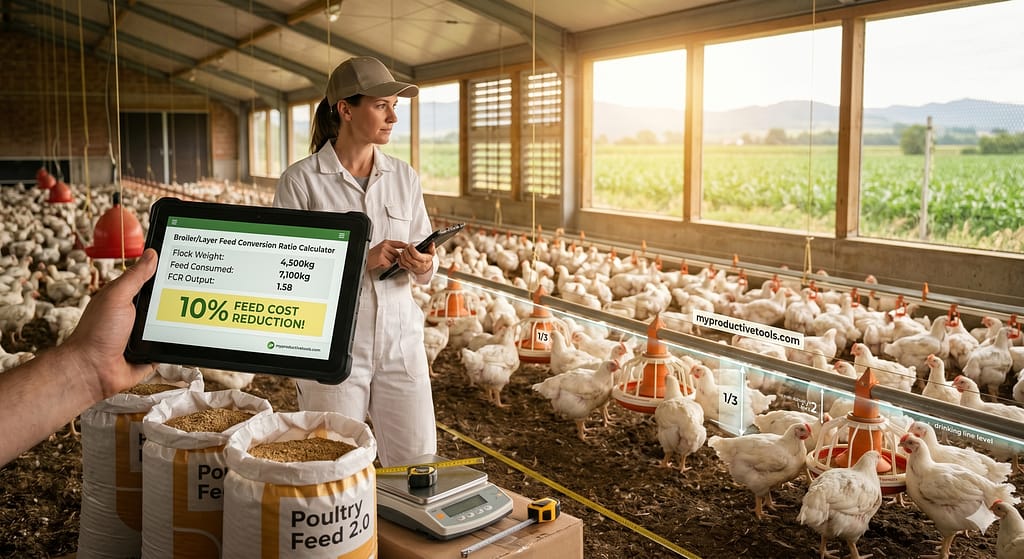
Want to lower your feed bills? Learn how to improve your poultry FCR and cut feed costs by 10%, spot hidden waste, and use an automated tracking tool.
In commercial poultry farming, managing operational expenditures is a non-stop battle. Whether you are running a small backyard homestead or overseeing a large-scale commercial operation, one financial reality remains constant: feed represents roughly 60% to 70% of your total production costs. Because feed takes up such a massive portion of your budget, even a minor increase in feed wastage or a slight drop in flock metabolic efficiency can completely erase your profit margins.
To keep your agribusiness profitable, you must closely monitor your Feed Conversion Ratio ($FCR$). Your FCR is a critical biological efficiency metric that tells you exactly how many kilograms of feed your birds need to consume to produce one kilogram of live body weight (for broilers) or a dozen eggs (for layers).
By identifying hidden systemic leaks, optimizing your hardware setups, and utilizing a digital Broiler/Layer Feed Conversion Ratio Calculator, you can catch financial drains early and cut your feed expenses down significantly.
How to Improve Your Poultry FCR: The Core Math of Poultry Efficiency
Before diving into operational adjustments, it’s vital to master the standard mathematical equations used to track your flock’s efficiency.
For meat-producing birds, the formula is calculated by dividing the total weight of feed consumed by the net live weight gained by your flock:
$\text{Broiler FCR} = \frac{\text{Total Feed Consumed (kg){\text{Total Live Weight Gained (kg)}}$$
For egg-producing flocks, the calculation shifts to measure feed weight against structural egg output:
$\text{Layer FCR (per Dozen Eggs)} = \frac{\text{Total Feed Consumed (kg)}}{\text{Total Dozen Eggs Produced}}$$
The Financial Impact of a Lower FCR
A lower numerical FCR score means your birds are highly efficient at converting raw dietary nutrients into sellable farm products. For example, if your broiler flock drops its FCR from $1.60$ down to $1.50$, it means you are using less feed to achieve the exact same market weight. When multiplied across thousands of birds, that tiny decimal shift saves tons of feed inventory.
Just like a landscape designer uses precise measurements to answer residential layout questions like, “how much mulch do I need” before buying materials, a poultry manager must use automated tracking tools to establish a data baseline. Instead of running these complex flock calculations by hand, you can instantly check your efficiency metrics using the free Broiler/Layer Feed Conversion Ratio Calculator.
3 Hidden Vulnerabilities Drastically Increasing Your Feed Bills
If your farm’s current FCR metrics are higher than standard breeder benchmarks, it is highly likely that your property is suffering from one of three common operational inefficiencies.
1. Unchecked Mechanical Feed Wastage
A shocking amount of feed loss doesn’t happen inside the bird’s digestive tract—it happens directly on the litter floor. If your hanging tube feeders or automatic pan lines are filled all the way to the brim, your birds will naturally scratch, peck, and bill the feed over the edges. Once premium crumbles or pellets fall into the wood shavings, they become soiled, mixed with manure, and completely lost to your bottom line.
2. Improper Feeder Height Adjustments
As broilers grow rapidly week by week, your feeding equipment must be raised to match their changing skeletal architecture.
- The Rule of Thumb: The lip of the feed pan or tube should always sit perfectly level with the birds’ breast height.
- The Consequence: If the feeders are positioned too low, the birds can easily step into the pans, scratch out the feed, and contaminate the supply. If they are positioned too high, weaker birds will struggle to access the feed, resulting in uneven flock uniformity and a bloated total FCR.
+-----------------------------------------------------------------+
|                  CORRECT FEEDER HEIGHT CONFIGURATION            |
|                                                                 |
|  Too Low  ---> Causes billing, scratching, and severe floor waste|
|  Too High ---> Restricts water/feed access, ruins flock uniformity|
|  Correct  ---> Lip of pan sits perfectly level with bird's breast|
+-----------------------------------------------------------------+
3. High Environmental House Temperatures
Poultry are warm-blooded animals that use feed energy to regulate their core body temperatures. If your poultry house lacks proper ventilation or cooling pads during hot summer months, your birds will experience heat stress. To cope, they will drastically reduce their feed intake while drinking excessive amounts of water, causing their average daily gain ($ADG$) to plunge and making your total FCR climb.
Actionable Strategies to Secure a 10% Feed Cost Reduction
To actively stop these financial leaks and pull your operational costs down, implement these three agronomic management protocols immediately.
Implement Strict Feed Level Restrictions
Never fill your automated pans or manual feed troughs to capacity. According to peer-reviewed poultry production guidelines from the University of Georgia Extension, maintaining feed pans at a one-third (1/3) depth setting reduces mechanical floor billing waste to almost zero. Filling pans to half-depth increases waste by up to 10%, while filling them completely can lead to a staggering 29% loss of raw product.
Optimize Your Water-to-Feed Ratios
Birds cannot digest their feed efficiently without adequate hydration. For every 1 kilogram of feed consumed, a healthy broiler typically requires roughly 2 liters of clean, cool water. Ensure your nipple drinker lines are delivering correct flow rates (measured in milliliters per minute) and check your water pressure settings weekly. If water delivery is restricted, feed intake drops sharply, and digestion slows down, which negatively impacts your feed efficiency.
Perform Weekly Data Benchmarking
You cannot manage what you do not measure. Waiting until the end of a 6-week grow-out cycle to calculate your performance means you are diagnosing financial issues far too late to fix them. Successful livestock managers run calculations every single week.
+-----------------------------------------------------------------+
|                    WEEKLY PERFORMANCE CHECKLIST                 |
|                                                                 |
|  1. Weigh a random sample of 50 to 100 birds to find average wt|
|  2. Reconcile total feed bags consumed over the past 7 days     |
|  3. Run data through an automated FCR tracking engine           |
+-----------------------------------------------------------------+
When you look at your weekly farm data spreadsheets and find yourself asking management questions similar to how a home landscaper asks, “how much mulch do I need to cover this space efficiently?” you are shifting from guesswork to data-driven farming. Log your weekly sample weights directly into the Broiler/Layer Feed Conversion Ratio Calculator to monitor performance spikes in real time.
Troubleshooting High FCR: A Real-World Financial Case Study
Let’s look at the financial math behind an unoptimized commercial flock to see how a 10% cost reduction plays out in actual cash reserves. Suppose a farmer is raising a batch of 5,000 commercial broilers with a target market weight of 2.0 kilograms per bird. The local cost of premium finisher feed is $0.50 per kilogram.
Scenario A: The Unoptimized Flock (FCR of 1.75)
- Total meat target: $5,000 \times 2.0\text{ kg} = 10,000\text{ kg}$ of live biomass.
- Total feed required: $10,000\text{ kg} \times 1.75 = 17,500\text{ kg}$ of feed.
- Total Feed Cost: $17,500 \times \$0.50 = \mathbf{\$8,750.00}$
Scenario B: The Optimized Flock (FCR of 1.55)
By lowering feed pan depths, adjusting hanging lines to breast height, and monitoring metrics weekly, the farmer optimizes bird digestion and cuts floor waste, reducing the flock’s FCR down to 1.55.
- Total meat target: $10,000\text{ kg}$ of live biomass.
- Total feed required: $10,000\text{ kg} \times 1.55 = 15,500\text{ kg}$ of feed.
- Total Feed Cost: $15,500 \times \$0.50 = \mathbf{\$7,750.00}$
+-----------------------------------------------------------------+
|                    POULTRY FLOCK COST COMPARISON                |
|                                                                 |
|  Unoptimized Feed Bill (1.75 FCR):   $8,750.00                  |
|  Optimized Feed Bill (1.55 FCR):     $7,750.00                  |
|  -------------------------------------------------------------  |
|  TOTAL OPERATIONAL SAVINGS:          $1,000.00 NET CASH         |
+-----------------------------------------------------------------+
By leveraging data-driven management, this farmer saves exactly $1,000.00 cash on a single batch of birds. This extra money can now be reinvested directly into biosecurity upgrades, better brooding heating systems, or solar-powered ventilation fans.
Final Strategy: Take Control of Your Poultry Profits
In modern animal agriculture, market feed prices are largely out of your direct control due to global grain market shifts. However, your farm’s internal feed efficiency is entirely within your control.
The next time you evaluate your feed inventory and ask yourself, “how much mulch do I need or how many feed bags do I need to pull this cycle through successfully?” treat your feed inputs with extreme precision. Stop letting your profits slip away into the floor litter shavings. Keep your feed lines at the proper heights, maintain low feed depths, and utilize the Broiler/Layer Feed Conversion Ratio Calculator to track your metrics every single week.
For further reading on commercial performance standards, lighting charts, and flock nutritional requirements, explore the technical reference manuals published by the World Poultry Science Association (WPSA). Keep your FCR low and your farm profitable!