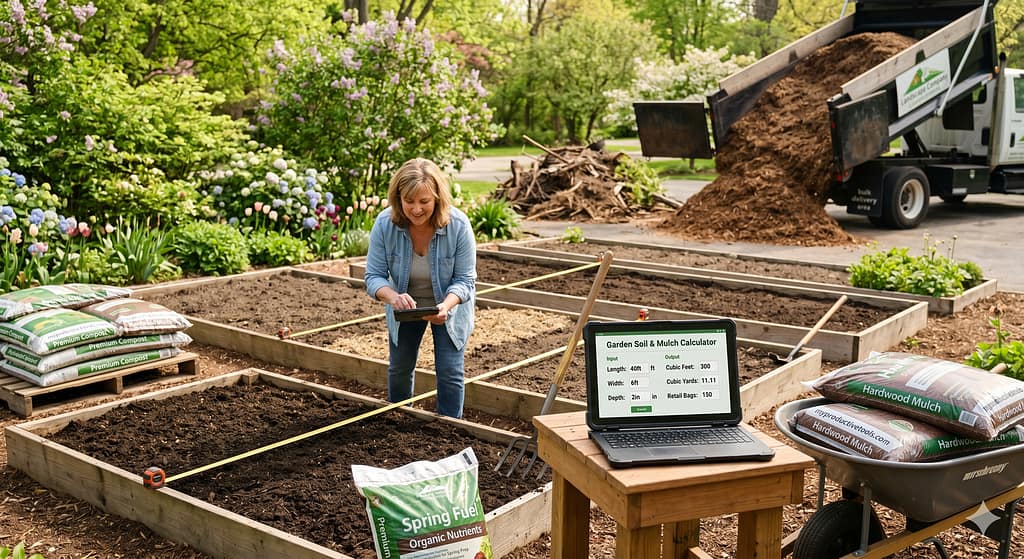
Spring Garden Prep: Ready for spring planting? Stop wondering how much mulch do I need to revamp your yard. Discover our 4-step checklist to optimize soil beds and calculate compost volumes perfectly.
As the winter frost melts away and the days grow longer, gardeners everywhere feel the familiar urge to head outside and get their hands dirty. Spring is the ultimate season of renewal, making it the most critical time of the year for structural garden preparation. The actions you take during these few vital weeks will directly dictate your landscaping beauty, soil fertility, and overall crop performance for the rest of the year.
However, diving headfirst into spring planting without a clear strategy often leads to half-baked soil preparation, uneven nutrient distribution, and chaotic budgeting. To avoid these common hurdles, seasoned growers rely on data-driven seasonal checklists to manage their outdoor spaces efficiently.
By focusing systematically on physical soil renovation, precision composting math, and digital volume estimation via the Garden Soil & Mulch Calculator, you can completely optimize your spring layout and set your property up for a highly successful growing season.
Spring Garden Prep Step 1: Execute Soil Renovation and Bed Maintenance
The very first phase of spring preparation involves assessing how your garden beds weathered the harsh winter elements. Over months of rain, snow, and freezing temperatures, soil naturally compacts, vital nutrients leach out of the upper rhizosphere, and opportunistic winter weeds quietly establish deep root networks.
Before you add any new amendments, you must renovate the existing foundation:
- Clear the Canvas: Manually strip away any dead plant debris, rotting old crops, and persistent weeds from your beds. Leaving diseased plant tissue behind can overwinter harmful fungal spores and insect larvae directly into your fresh spring soil.
- Test the Structure: Take a handful of your garden soil and squeeze it gently. If it forms a rock-hard, unyielding ball of mud, your ground is too wet and compacted to work yet. Let it dry out for a few more sunny days. If it crumbles beautifully like chocolate cake crumbs, your soil structure is perfectly primed for aeration.
- Gently Loosen the Ground: Avoid heavy, mechanized tilling, which destroys complex soil food webs and slices up beneficial earthworms. Instead, use a manual garden broadfork or a sturdy digging fork to gently prize up and fracture the compacted soil layers. This allows fresh oxygen, spring rain, and new plant roots to penetrate effortlessly into the ground.
During this structural renovation phase, you will likely realize that your soil levels have dropped due to natural decomposition. To see exactly how much material you need to add to top off your borders, open the Garden Soil & Mulch Calculator in another tab to track your upcoming replenishment volumes.
Step 2: Master Your Spring Composting Math
Once your existing garden beds are loose, clear, and fully aerated, it is time to feed the soil biology. Applying a fresh layer of organic matter in the spring is non-negotiable for sustainable soil health. Organic compost replenishes vital macronutrients, fuels beneficial microbial activity, and drastically improves the moisture-retention capabilities of sandy or heavy clay soil types.
But how do you avoid under-applying or over-purchasing compost? You must approach this step with exact volumetric math rather than relying on loose visual guesswork.
+-------------------------------------------------------------------+
|                  SPRING AMENDMENT DEPTH CONFIGURATIONS            |
|                                                                 |
|   Compost Top-Dressing (Annual Refresh):   1 to 2 Inches          |
|   New Raised Bed Blend (Full Buildout):    6 to 12+ Inches        |
|   Heavy Clay Soil Amending (Deep Mix):     3 to 4 Inches          |
+-------------------------------------------------------------------+
For an annual spring nutritional refresh, agricultural extensions universally recommend spreading a uniform 1-to-2-inch layer of high-quality compost across your entire planting layout.
To calculate your precise compost volume requirement manually, multiply your layout’s square footage by your desired depth fraction:
$$\text{Cubic Feet of Compost} = \text{Total Square Footage} \times \left(\frac{\text{Desired Depth in Inches}}{12}\right)$$
For instance, if you manage a small suburban backyard layout with 300 square feet of designated growing beds, and you want to apply a 2-inch nutritional blanket of dark mushroom compost:
$$\text{Cubic Feet} = 300 \times \left(\frac{2}{12}\right) = 300 \times 0.166 = 50\text{ cubic feet}$$
To instantly see how many standard retail compost bags or bulk commercial yards that total volume represents, save time by running your numbers through the Garden Soil & Mulch Calculator.
Step 3: Run Volume Estimations for Weed Barriers
With your beds fully renovated and heavily charged with fresh organic compost, your next strategic priority is long-term weed prevention and moisture conservation. As spring temperatures warm up the soil, millions of dormant weed seeds will rapidly germinate and compete with your prized flowers and vegetables for water and sunlight.
Spreading a clean, thick layer of organic mulch is your absolute best defensive weapon against this seasonal onslaught. However, before heading down to the local nursery, every homeowner runs into the exact same seasonal calculation dilemma: “how much mulch do I need to completely insulate my property this year?”
Leaving this question to visual guesswork typically results in patchy, ultra-thin layers that fail to stop weeds, or massive over-purchases that waste your weekend budget.
Calculating Your Protective Blanket
To achieve effective weed suppression and lock in critical soil moisture ahead of the hot summer months, you need to maintain a consistent depth configuration of 3 inches of bark or wood chips. Let’s look at how to run this volume estimation for a standard home landscaping layout:
Suppose you have a series of perimeter flower beds framing your house that measure 150 feet long by 4 feet wide.
- Find the Total Surface Area: $150\text{ ft} \times 4\text{ ft} = 600\text{ square feet}$.
- Convert the Depth: A target depth of 3 inches converts to $0.25\text{ feet}$ ($3 \div 12 = 0.25$).
- Execute the Volumetric Formula:$$\text{Cubic Feet} = 600\text{ sq ft} \times 0.25\text{ ft} = 150\text{ cubic feet}$$
- Convert to Bulk Yards: Since commercial delivery trucks sell bulk bark by the yard, divide your cubic feet by 27:$$\text{Cubic Yards} = \frac{150}{27} \approx 5.55\text{ cubic yards}$$
Instead of stressing over complex spatial geometry or rounding errors, you can easily streamline this entire workflow by using the automated Garden Soil & Mulch Calculator to get an instant, error-free measurement breakdown.
Step 4: Map Your Layout to the Perfect Purchasing Strategy
Now that you have executed your manual measurements and calculated your exact seasonal volume demands for both compost and mulch, you can confidently build a highly cost-effective shopping strategy. Knowing your exact numbers protects you from predatory landscape delivery fees and prevents multiple time-wasting trips to retail stores.
Consider this helpful guide to match your calculated spring volumes to the most economical purchasing channel:
- Small Layouts (Under 20 Cubic Feet): Ideal for individual retail bags. If you calculated that you need 10 cubic feet of material, buying five standard 2-cubic-foot bags fits easily into a standard car trunk and handles effortlessly.
- Medium Layouts (20 to 45 Cubic Feet): The financial gray area. If you own a pickup truck, driving down to a local nursery to have them drop a single tractor-scoop of loose bulk material into your truck bed is incredibly cheap. If you don’t own a truck, buying retail bags in bulk on a pallet is often your most logical path.
- Large Layouts (Over 45 Cubic Feet / 1.7 Cubic Yards): Absolute bulk delivery territory. Ordering a single commercial dump truck delivery is vastly cheaper per cubic foot than buying dozens of plastic bags, and it drastically cuts down on single-use plastic waste across your homestead.
According to residential consumer landscaping studies published by academic institutions like the Oregon State University Extension Service, buying bulk organic materials for large yard revamps reduces raw material acquisition costs by up to 40% to 60% compared to equivalent retail bag purchases.
+-----------------------------------------------------------------+
|                    SPRING PURCHASING MATRIX                     |
|                                                                 |
|  < 20 Cubic Feet   ---> Retail Bags (Maximum Convenience)       |
|  20 - 45 Cubic Feet ---> Pickup Truck Bed (Budget Conscious)    |
|  > 45 Cubic Feet   ---> Bulk Dump Truck (Maximum Savings)       |
+-----------------------------------------------------------------+
When you are standing in the middle of a chaotic local garden center surrounded by hundreds of products, having your exact volumetric needs written down keeps your project completely organized and under budget.
Final Strategy: Streamline Your Spring Workflow
Spring garden prep doesn’t have to be an exhausting, chaotic process dictated by stressful guesswork and unexpected financial surprises. By breaking your seasonal yard setup down into a structured, step-by-step checklist, you can confidently upgrade your soil quality, feed your plants premium nutrition, and suppress weeds long before the summer heat arrives.
The next time you look out at your bare garden beds in the early morning sun and ask yourself, “how much mulch do I need to pull this entire layout together?” remember that the math is completely on your side. Step outside with a reliable tape measure, map your primary geometric cultivation zones, and use the Garden Soil & Mulch Calculator to secure instant, data-driven precision for your home. Happy spring gardening!