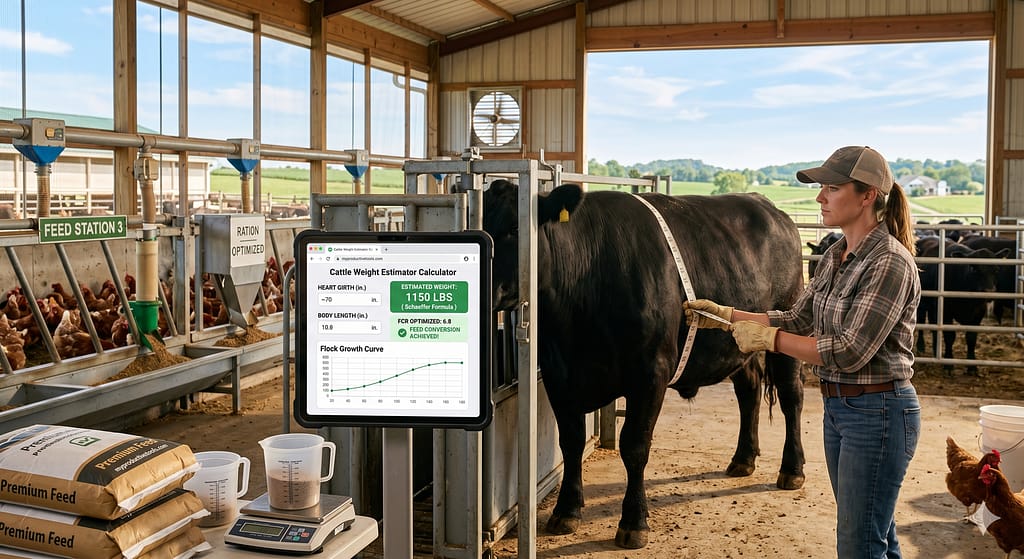
Are Your Cows Gaining Weight? Discover how to estimate cattle weight without a scale to monitor feed conversion ratios and boost herd efficiency.
In modern livestock production, managing feed inputs is the single most important factor determining your farm’s survival. Whether you are operating a full-scale commercial feedlot or rotational-grazing a small herd of grass-finished steers on an organic homestead, your feed costs represent your largest recurring line-item expenditure. Because feed values remain high, you simply cannot afford to support animals that consume massive amounts of forage or grain without converting those resources into matching structural growth.
To optimize your agribusiness profits, you must track your herd’s Feed Conversion Ratio ($FCR$). FCR is a critical biological efficiency metric that tells you exactly how many pounds of feed an animal must consume to produce one single pound of live body weight gain.
By identifying hidden performance leaks, executing consistent anatomical measurements, and learning how to estimate cattle weight without a scale, you can use the free Free Cattle Weight Estimator Calculator to eliminate feed-wasting cattle from your pastures permanently.
Are Your Cows Gaining Weight? The Biological Math of Ruminant Feed Conversion
To evaluate feed efficiency accurately, you must first master the mathematical relationship between feed intake and biomass accumulation. The basic formula used to compute livestock FCR over a specific feeding trial or grazing window is:
$$\text{Feed Conversion Ratio (FCR)} = \frac{\text{Total Feed Consumed (lbs Dry Matter)}}{\text{Total Live Weight Gained (lbs)}}$$
Why a Lower FCR Score Equals Higher Profit
A lower numerical FCR score means an animal is highly efficient at processing nutrients. For example, if Steer A features an FCR of $6.0$, it requires 6 pounds of feed to gain 1 pound of muscle. If Steer B has a poor FCR of $8.5$, it burns 8.5 pounds of feed to hit that exact same growth milestone.
+-----------------------------------------------------------------+
|                  FEED CONVERSION RATIO BENCHMARKS               |
|                                                                 |
|   Elite Feedlot Conversion Rate:     5.0 to 6.5 FCR             |
|   Average Grass-Finished Pasture:    7.0 to 9.0 FCR             |
|   Unoptimized / Wasteful Animals:    10.0+ FCR (Financial Leak) |
+-----------------------------------------------------------------+
Tracking this metabolic variance across your herd is impossible if you don’t have a reliable method to monitor weight fluctuations over time. Luckily, learning how to estimate cattle weight without a scale gives you an objective data stream. By pulling a tape around the heart girth and frame length, then processing those dimensions through the Free Cattle Weight Estimator Calculator, you can continuously check weight fluctuations without needing multi-thousand-dollar platform hardware.
3 Critical Operational Leaks Harming Your Herd’s FCR
When you regularly track your herd’s performance, you will quickly notice that some animals simply lag behind. A high flock FCR is typically triggered by three hidden operational or biological issues.
1. Hardcore Metabolic “Feed-Wasters”
Just like humans, individual cattle possess unique genetic metabolic rates. Two heifers born on the exact same day from the same bull can exhibit completely separate feed conversion profiles. A “feed-waster” keeps eating your premium winter hay but funnels that energy into heat dissipation or manure output rather than muscle tissue accumulation. Identifying and culling these low-efficiency passenger animals instantly lowers your overall operational overhead.
2. High Internal Parasite Burdens
Even if you are providing top-tier, high-protein alfalfa or grain supplements, your herd’s FCR will plummet if your animals are suffering from sub-clinical parasite infections. Worms, liver flukes, and coccidia damage the structural lining of the ruminant stomach, blocking nutrient absorption. The cow will continue to eat heavily, but because the parasites are stealing the nutrients, your calculated growth rate stalls out.
3. Sub-Optimal Forage Quality and Digestibility
Cattle are ruminants designed to convert cellulose into protein, but the quality of your pasture matters heavily. Mature, wood-like grasses contain high levels of lignin, which passes through the digestive tract without breaking down completely. If your forage is poor, the animals burn excess metabolic energy simply trying to digest the tough fiber, causing their average daily gain to drop while feed intake remains high.
To monitor how these variables are impacting your livestock in real time, keep the Free Cattle Weight Estimator Calculator bookmarked on your mobile device during field checks.
How to Optimize Your Feed Management Using Spatial Data
Transitioning to a data-driven feed management model is straightforward. You can achieve excellent livestock tracking accuracy by integrating these simple management routines:
- Calculate Individual Efficiency Curves: Take heart girth and length records at the start of a new pasture rotation and repeat the process 30 days later. This isolated data reveals exactly which individual animals are gaining weight rapidly and which ones are plateauing on your grass.
- Match Nutritional Energy to Structural Needs: Use your calculated weight data to balance your winter feed rations. Heavy pregnant cows require separate, targeted nutrient profiles compared to rapidly growing backgrounder calves.
- Select Replacement Heifers Using Data Baseline: When choosing which young heifers to keep for your permanent breeding herd, prioritize daughters of cows that maintain high body condition scores while consuming less forage.
+-----------------------------------------------------------------+
|                    WEEKLY FEED AUDIT PROTOCOL                   |
|                                                                 |
|  1. Measure structural heart girth and body length tracks       |
|  2. Process values to establish growth curves without a scale    |
|  3. Cull bottom 10% poor-performing, low-conversion animals     |
+-----------------------------------------------------------------+
When you incorporate these metrics into your ranch records, asking yourself “how to estimate cattle weight without a scale cleanly to analyze my monthly feed efficiency?” becomes a natural part of your farm administration. By combining an industrial measuring tape with the processing power of the Free Cattle Weight Estimator Calculator, you gain the financial intelligence required to run a highly profitable livestock business.
Troubleshooting Feed Waste: An Economic Blueprint
Let’s look at the financial math behind an unoptimized backgrounding operation to see how tracking feed conversion numbers impacts your cash reserves. Suppose a farmer is wintering a group of 30 feeder steers over a 60-day period. The market cost of mixed hay and ration supplements is $0.12 per pound of dry matter.
Case A: The Unoptimized, Low-Efficiency Herd (Average FCR of 9.5)
Because the farmer relies on visual guesswork and fails to cull low-performing animals, the herd displays poor feed processing metrics.
- Total target weight gain across the group: 6,000 lbs.
- Total feed required to hit target: $6,000 \times 9.5 = 57,000\text{ lbs}$ of feed.
- Total Seasonal Feed Bill: $57,000 \times \$0.12 = \mathbf{\$6,840.00}$
Case B: The Data-Driven, Optimized Herd (Average FCR of 7.0)
By running tape measurements, tracking performance trends, and culling the bottom 10% of poor-performing animals, the producer improves the herd’s average FCR down to a clean 7.0.
- Total target weight gain across the group: 6,000 lbs.
- Total feed required to hit target: $6,000 \times 7.0 = 42,000\text{ lbs}$ of feed.
- Total Seasonal Feed Bill: $42,000 \times \$0.12 = \mathbf{\$5,040.00}$
+-----------------------------------------------------------------+
|                    SEASONAL FEED COST COMPARISON                |
|                                                                 |
|  Unoptimized Feed Expense (9.5 FCR):   $6,840.00                |
|  Optimized Feed Expense   (7.0 FCR):   $5,040.00                |
|  -------------------------------------------------------------  |
|  TOTAL OPERATIONAL OVERHEAD SAVINGS:    $1,800.00 NET CASH      |
+-----------------------------------------------------------------+
By leveraging digital estimation data, this rancher saves exactly $1,800.00 cash in a single winter season—drastically lowering production costs per pound of beef produced.
Final Strategy: Take Control of Your Input Expenses
In modern commercial cattle farming, you cannot alter the wholesale market value of hay or grain bags. However, your animals’ internal conversion performance is fully within your sphere of control. Stop letting your profits slip away into unoptimized forage consumption. Keep your pastures rotated, address internal parasites quickly, and use data to monitor performance trends.
The next time you walk your fence lines and find yourself wondering “how to estimate cattle weight without a scale safely to ensure my feed rations are paying off?” let mathematics guide your management strategy. Grab a durable tape measure, record your animals’ anatomical dimensions, and let the Free Cattle Weight Estimator Calculator handle the conversion processing for you.
For additional research on ruminant nutrition, dry matter intake calculations, and methane emission reduction frameworks, explore the technical open-access databases maintained by the Beef Cattle Research Council (BCRC). Keep your feed conversion sharp and your farm profitable!