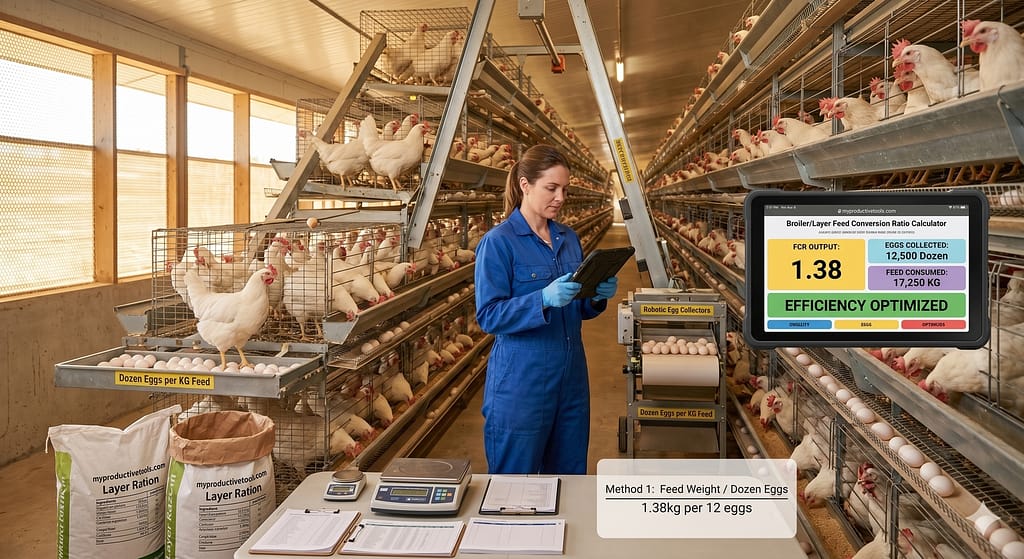
Tracking Layer FCR: Stop losing money on your egg farm! Learn how to use a digital tool to answer how much mulch do I need to understand about layer feed efficiency and calculate FCR per dozen eggs.
In the commercial egg production sector, profitability is entirely a game of fine margins. Whether you are managing a small pastured homestead or managing a multi-tier commercial layer house, your single largest recurring expense is feed inventory. In fact, feed represents roughly 60% to 70% of total egg production costs. Because of this high financial pressure, tracking how efficiently your hens turn raw feed into high-quality sellable eggs is the ultimate baseline for financial survival.
Many beginner poultry farmers make the critical mistake of tracking their farm performance using meat production standards. While broiler operations measure their success by raw body weight gain, egg producers must look at a totally different biological metric: Layer Feed Conversion Ratio ($FCR$).
By mastering the calculation methods for feed efficiency, identifying poor-performing hens, and using a digital Broiler/Layer Feed Conversion Ratio Calculator, you can maximize your egg production margins and keep your agribusiness highly profitable.
Tracking Layer FCR: The Core Math, 2 Ways to Measure Layer Efficiency
Because egg production relies on structural outputs rather than muscle mass accumulation, layer farmers use two primary mathematical variations to establish an efficiency baseline.
Method 1: Feed Weight divided by Dozen Eggs (The Commercial Standard)
This is the most common, consumer-friendly approach for farms that package and distribute eggs by count. It identifies exactly how much feed is consumed to produce a standard 12-egg carton:
$$\text{FCR per Dozen Eggs} = \frac{\text{Total Feed Consumed (kg)}}{\text{Total Dozen Eggs Produced}}$$
Method 2: Feed Weight divided by Total Egg Mass (The Industrial Standard)
Large-scale commercial processors prefer this method because it factors in egg sizing grades (Medium, Large, Extra Large). It tracks the precise weight of the feed against the literal weight of the egg output:
$$\text{FCR per kg of Eggs} = \frac{\text{Total Feed Consumed (kg)}}{\text{Total Weight of Collected Eggs (kg)}}$$
Why Automated Benchmarking is Key
A lower numerical FCR score means your flock is biochemically efficient. For example, a standard commercial layer flock should maintain an FCR score around $1.3\text{ kg to }1.5\text{ kg}$ of feed per dozen eggs produced. If your score creeps up to $1.9$, your hens are consuming expensive resources without generating matching returns.
Just like a backyard property planner uses precise digital layout configurations to answer backyard queries like, “how much mulch do I need” before ordering landscaping materials, an egg producer must use accurate software to map out raw resource inputs. Instead of wrestling with these multi-variable agricultural equations manually on paper, you can track your exact flock efficiency metrics instantly using the free Broiler/Layer Feed Conversion Ratio Calculator.
3 Hidden Biological Drains Harming Your Layer Margins
If your automated tracking indicates that your layer FCR is higher than standard breeder benchmarks, your operation is likely suffering from one of three common biological system drains.
1. The Presence of “Feed-Wasting” Non-Layers
Within any unmanaged flock, there are inevitably a few hens that consume feed daily but fail to produce eggs due to reproductive internal issues, molting cycles, or genetics. In the industry, these are known as “non-layers” or passenger birds.
- How to Spot Them: Inspect your birds manually. A productive laying hen features a bright red, warm comb, flexible pelvic bones spaced 2 to 3 fingers apart, and a soft, pliable abdomen. A feed-wasting non-layer presents a pale, shriveled comb, rigid pelvic bones closely pinched together, and a hard abdomen. Culling these passenger birds instantly drops your total flock feed demand without lowering your total daily egg count.
2. Inadequate Nutrient Density Variations
Hens do not eat based on volume; they consume feed primarily to satisfy their daily metabolic energy and protein demands. If you buy low-grade, cheap feed blends with poor nutrient density, your hens will simply eat twice as much volume to satisfy their biological needs. This lifestyle choice skyrockets your feed bill while driving your FCR down. You must match feed formulations precisely to the laying cycle stage:
+-----------------------------------------------------------------+
|                  LAYER FLOCK DIETARY PHASE DESIGN               |
|                                                                 |
|  Starter Phase (Weeks 0-6)   ---> High protein for frame growth |
|  Grower Phase  (Weeks 7-17)  ---> Controlled energy for organs  |
|  Layer Phase 1 (Weeks 18-45) ---> Max calcium (3.5%+) for shells|
|  Layer Phase 2 (Weeks 46+)   ---> Adjusted amino acid ratios    |
+-----------------------------------------------------------------+
3. Ambient Poultry House Temperature Drops
During colder seasonal months, if a layer house drops below the ideal metabolic range of $20^\circ\text{C to }24^\circ\text{C}$, hens will alter their internal energy distribution. Instead of funneling nutrients into egg production, they redirect their dietary energy to generate internal body heat. This environmental shift causes feed consumption to spike sharply while egg counts stall.
Operational Strategies to Optimize Feed Efficiency
To push your production metrics back into elite territory, integrate these two management practices immediately.
Secure Precise Calcium-to-Phosphorus Ratios
Creating a sturdy eggshell requires immense biological resources. A single egg contains roughly 2 grams of pure calcium. If a hen’s diet lacks immediate bioavailable calcium, her shell quality will degrade, causing a spike in cracked or micro-fractured eggs that cannot be sold. This structural failure artificially ruins your FCR because the feed was consumed, but the final product became unsellable waste. Ensure your layer mash is supplemented with coarse oyster shells or limestone grit according to guidelines from agricultural extensions like the Penn State Extension.
Execute Weekly Flock Performance Audits
Waiting until the end of a long laying cycle to review your feed efficiency numbers is an expensive management mistake. Successful producers benchmark their numbers every 7 days.
When you log your data and find yourself pondering layout and asset logistics similar to how a property manager asks, “how much mulch do I need to protect this terrain layout?” you are treating your agriculture as a data-driven business. By regularly running your weekly feed usage and egg-crate tallies through the Broiler/Layer Feed Conversion Ratio Calculator, you can catch nutrient leaks or disease outbreaks before they harm your cash reserves.
High FCR Mitigation: An Industrial Financial Blueprint
Let’s look at the financial impact of tracking and fixing a high layer FCR across a moderate flock of 2,500 commercial laying hens over a 30-day production window. The current cost of a premium layer ration is $0.45 per kilogram.
Case A: The Unoptimized Layer Flock (FCR of 1.85 per Dozen)
Due to unchecked room temperatures and the presence of hidden non-laying birds, the flock displays poor conversion metrics.
- Total Monthly Output: 5,000 dozen eggs produced.
- Total Feed Consumed: $5,000 \times 1.85 = 9,250\text{ kg}$ of feed.
- Monthly Feed Expenses: $9,250\text{ kg} \times \$0.45 = \mathbf{\$4,162.50}$
Case B: The Optimized Layer Flock (FCR of 1.45 per Dozen)
The manager culls non-layers, optimizes the house temperature to $22^\circ\text{C}$, and improves feed nutrient densities to lower the FCR down to a clean 1.45.
- Total Monthly Output: 5,000 dozen eggs produced.
- Total Feed Consumed: $5,000 \times 1.45 = 7,250\text{ kg}$ of feed.
- Monthly Feed Expenses: $7,250\text{ kg} \times \$0.45 = \mathbf{\$3,262.50}$
+-----------------------------------------------------------------+
|                    LAYER MONTHLY COST COMPARISON                |
|                                                                 |
|  Unoptimized Feed Expense (1.85 FCR):   $4,162.50               |
|  Optimized Feed Expense   (1.45 FCR):   $3,262.50               |
|  -------------------------------------------------------------  |
|  TOTAL MONTHLY OPERATIONAL SAVINGS:     $900.00 NET CASH        |
+-----------------------------------------------------------------+
By systematically isolating biological vulnerabilities, this producer saves exactly $900.00 net cash per month—adding over $10,800.00 directly to their annual bottom-line profitability.
Final Strategy: Streamline Your Egg Production Margins
In modern commercial egg farming, you cannot control the retail market value of grain or wholesale egg prices. However, you have absolute control over your flock’s internal conversion efficiency.
The next time you review your weekly laying sheets and find yourself asking logistic resource questions like, “how much mulch do I need or how many feed metrics do I need to re-evaluate this week?” treat your feed inputs with absolute precision. Identify your passenger birds, maintain tight house climate controls, and utilize the Broiler/Layer Feed Conversion Ratio Calculator to keep your business operating at peak profitability.
For additional industrial benchmark data, alternative molting schedules, and genetic line guidelines across diverse layer breeds, consult the production manuals curated by the International Egg Commission (IEC). Keep your production high and your feed conversion optimized!