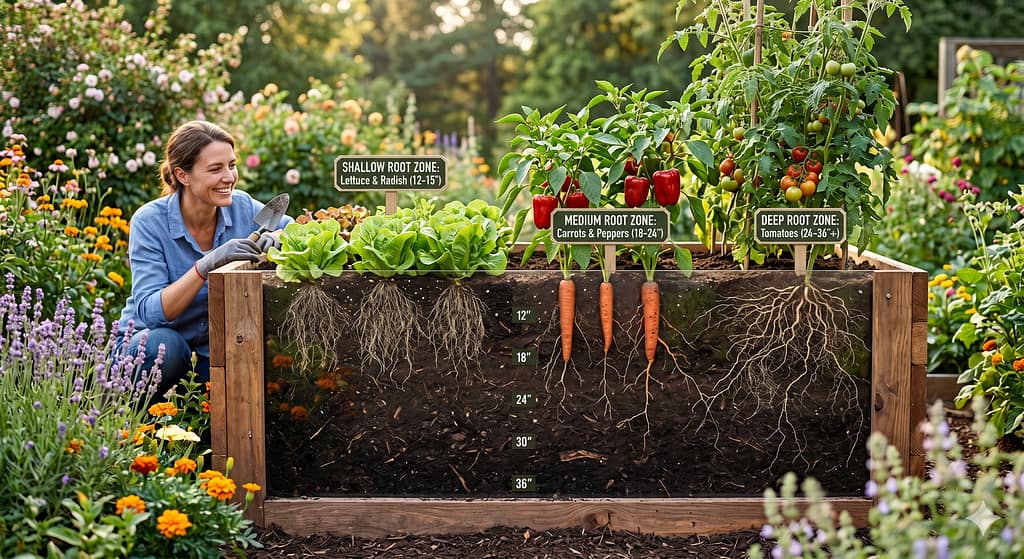
Wondering the science of soil depth and how much mulch do you need or how deep to build your soil? Discover the 3 root zones of vegetables and optimize depth configurations for maximum crop yield.
When setting up a backyard homestead or a small-scale market garden, the focus is almost always on what happens above the surface. We monitor leaf color, build elaborate staking systems for tomatoes, and watch daily for the first signs of fruit development. However, any experienced agronomist or botanist will tell you that agricultural success is entirely dictated by what happens underground.
The depth of your topsoil acts as the physical, chemical, and biological engine room for your crops. If your soil layer is too shallow, your plants will become structurally unstable, nutrient-deficient, and highly susceptible to drought stress. If it is unnecessarily deep, you waste significant capital resources filling space that plant roots will never actually reach.
To optimize your layout for maximum crop yield and biological efficiency, you must master the science of root depth. By understanding the three distinct vegetable root zones and utilizing the Garden Soil & Mulch Calculator, you can input the precise depth configuration your garden needs to thrive.
The Science of Soil Depth:The Biological Importance of Root Space
To understand why configuration depth matters, we must look at the physiological functions of a vegetable plant’s root system. Roots do not simply hold a plant upright; they are highly dynamic organs responsible for three critical survival mechanisms:
- Nutrient Acquisition: Plants absorb essential macronutrients (Nitrogen, Phosphorus, and Potassium) alongside micronutrients through specialized root hairs. Shallow soil restricts the total surface area available for nutrient uptake, resulting in stunted growth.
- Hydration Management: Deeper soil profiles retain a reservoir of moisture long after the top layer dries out. Deep-rooted crops can survive intense summer heatwaves because their roots tap into these sub-surface water supplies.
- Microbial Symbiosis: The area immediately surrounding plant roots—the rhizosphere—is home to billions of beneficial bacteria and mycorrhizal fungi. A deep rhizosphere allows these microbes to cycle nutrients effectively, feeding your crops naturally.
When planning your bed layouts, you might find yourself asking common layout questions like, “how much mulch do I need or how much topsoil should I buy?” The answer begins by categorizing your target crops into their respective biological root classifications.
The 3 Vegetable Root Classifications
Not all vegetables are anatomically identical. Some species evolve to branch out horizontally along the surface, while others plunge deep vertical taproots into the earth. According to comprehensive crop production data from the UC Davis Vegetable Research and Information Center, agricultural crops generally fall into three distinct rooting depth categories:
+-------------------------------------------------------------------+
|                     VEGETABLE ROOT DEPTH ZONES                    |
|                                                                   |
|   [ Shallow Zone ]   12 to 18 Inches   (Lettuce, Onions, Radish)  |
|   [ Medium Zone  ]   18 to 24 Inches   (Beans, Carrots, Peppers)  |
|   [ Deep Zone    ]   24 to 36+ Inches  (Tomatoes, Squash, Corn)   |
+-------------------------------------------------------------------+
1. Shallow-Rooted Crops (12 to 18 Inches)
These plants have compact, fibrous root structures that stay close to the soil surface. They require a minimum depth configuration of 12 inches to produce a healthy harvest.
- Examples: Lettuce, spinach, onions, radishes, garlic, strawberries, and broccoli.
- Management Note: Because their roots are concentrated near the top, these crops require frequent, light watering and are highly sensitive to surface weed competition.
2. Medium-Rooted Crops (18 to 24 Inches)
These vegetables require a moderate soil profile to spread out their lateral support roots and access balanced nutrition.
- Examples: Bush beans, carrots, cucumbers, eggplants, peppers, peas, and turnips.
- Management Note: For root crops like carrots and parsnips, a loose, uncompacted depth configuration is mandatory. If these roots hit a hard clay barrier or rocks at 12 inches, they will split, deform, and lose market value.
3. Deep-Rooted Crops (24 to 36+ Inches)
These aggressive plants develop extensive, deep root networks or long taproots that pull resources from deep within the earth.
- Examples: Tomatoes, winter squash, pumpkins, sweet corn, asparagus, and sweet potatoes.
- Management Note: Tomatoes are unique because they can grow adventitious roots all along their stems. Planting them deep into a 24-inch optimized soil profile drastically increases their fruit yield and drought resistance.
Before ordering materials for these specific zones, open the Garden Soil & Mulch Calculator to easily map your target plant depths to physical bulk volumes.
Linking Soil Depth to Volumetric Math
Once you know the biological depth requirements of your chosen vegetable crops, you can use those parameters to drive your physical site math. Let’s look at how configuring different depths impacts your volume requirements.
Suppose you are building a dedicated market garden plot that measures 30 feet long by 4 feet wide. You can analyze how your crop selection alters your bulk ordering volume using the following cubic calculation:
$$\text{Cubic Feet} = \text{Length (ft)} \times \text{Width (ft)} \times \left(\frac{\text{Depth in Inches}}{12}\right)$$
- Scenario A (Shallow Crops – 12″ Depth):$$\text{Volume} = 30 \times 4 \times \left(\frac{12}{12}\right) = 120\text{ cubic feet}$$Dividing by 27 gives you 4.44 cubic yards of soil required.
- Scenario B (Deep Crops – 24″ Depth):$$\text{Volume} = 30 \times 4 \times \left(\frac{24}{12}\right) = 30 \times 4 \times 2 = 240\text{ cubic feet}$$Dividing by 27 gives you 8.88 cubic yards of soil required.
As you can see, matching your bed infrastructure to your specific plants prevents you from buying twice as much soil as you actually need. Rather than calculating these multi-tier scenarios manually, you can instantly run the math using the automated Garden Soil & Mulch Calculator.
Maximizing Yield with Layered Textures
If you discover that your deep-rooted crops like tomatoes need 24 inches of depth, but your budget doesn’t allow you to buy 9 cubic yards of premium loam, you can utilize soil science to optimize your costs. You do not need premium, high-dollar compost filling the bottom 12 inches of a deep bed.
Instead, implement a highly effective agronomic technique known as layered texture configuration:
- The Bottom Layer (Subsoil Zone): Fill the bottom 50% of your deep profile with native garden soil, clean fill dirt, or organic woody debris (a permaculture practice known as Hugelkultur). Deep roots will eventually reach this area for anchoring and water storage.
- The Top Layer (Rhizosphere Zone): Fill the top 12 to 18 inches with a premium, nutrient-dense raised bed blend containing compost and aeration elements. This is where 90% of your plant’s metabolic activity occurs.
- The Insulating Layer (Surface Zone): Protect the surface with a organic wood chip or straw covering. If you are standing in your yard wondering, “how much mulch do I need to insulate this entire setup?” remember that a standard 2-to-3-inch layer is ideal for regulating soil temperature and reducing water evaporation.
This layered approach ensures your plants get the biological depth they demand while keeping your upfront material costs as low as possible.
Final Strategy: Use Data-Driven Design for Your Garden
Every inch of topsoil you add to your garden layout represents a physical cost and a biological consequence. By moving away from random guessing and moving toward data-driven, crop-specific depth configurations, you create an optimized environment where your vegetables can maximize their genetic potential.
The next time you map out a new garden layout and find yourself wondering, “how much mulch do I need or how deep should my growing beds be this year?” rely on botany rather than guesswork. Measure your plot dimensions, check your crops’ root zones, and leverage the precise calculations offered by the Garden Soil & Mulch Calculator to build a highly productive, cost-effective backyard farm.
For additional data on soil classification, texture optimization, and nutrient management across diverse geographic profiles, explore the agricultural educational materials published by the USDA Natural Resources Conservation Service (NRCS).